


A complete The Hairy Ape study guide for students: plot, themes, characters, symbols, and exam-ready analysis
“The Hairy Ape” and the Language of Modern Dislocation
In The Hairy Ape, O’Neill presents alienation as a crisis of belonging. Yank believes that his physical labour gives him a secure identity, but Mildred’s rejection exposes the weakness of that identity. His failed movement through the ship, Fifth Avenue, the radical office, the prison, and the zoo turns the play’s settings into stages in a progressive loss of social and human connection.
Eugene O’Neill’s The Hairy Ape follows Yank Smith, a stoker who believes that his physical labour gives him a secure place in the modern industrial world. In the opening scene, he identifies himself with the force that drives the ship: “I’m de ting in coal dat makes it boin.” His confidence depends on a simple equation—he works, therefore he belongs.
- “The Hairy Ape” and the Language of Modern Dislocation
- Eugene O’Neill and the Historical Context of The Hairy Ape
- The Hairy Ape : Expressionism and Its European Cousins
- Plot Summary: The Hairy Ape Scene by Scene
- Characters in The Hairy Ape: Yank, Mildred, Paddy, and Long
- Themes in The Hairy Ape: Alienation, Class, and Identity
- Symbols and Imagery in The Hairy Ape: Cages, Steel, and the Gorilla
- Expressionism and Stagecraft in The Hairy Ape
- Critical Approaches to The Hairy Ape
- My Own Reading
- Exam-Style Questions on The Hairy Ape
That equation collapses when Mildred Douglas, the daughter of a wealthy steel manufacturer, enters the stokehole and calls him a “filthy beast.” She does not intend to begin a philosophical crisis, but her response exposes a division Yank has never needed to confront. The ship depends on his labour, yet the social class that owns the industrial system refuses to recognize him as fully human.
The play traces Yank’s unsuccessful search for another form of belonging. He confronts the wealthy pedestrians of Fifth Avenue, approaches a radical political organization, resists imprisonment, and finally turns to the gorilla in the zoo. Each setting offers a possible answer, but each reproduces the conditions of confinement that have shaped his life. The forecastle resembles a cage, the prison makes the image literal, and the zoo provides the final and fatal version of the motif.
O’Neill presents this journey through Expressionist stagecraft. Distorted settings, mechanical crowds, symbolic gestures, and exaggerated speech do not simply decorate the action; they represent Yank’s changing mental state. The play’s central question is therefore both social and psychological: what remains of a person when the work that has defined his identity no longer gives him a place among other people?
The rest of this guide examines how O’Neill builds that question through character, symbol, and stagecraft. It then outlines the eight-scene structure, analyses the major figures, and suggests approaches for examination essays and close reading.
Eugene O’Neill and the Historical Context of The Hairy Ape
Eugene O’Neill grew up backstage. His father, James, was a touring matinee idol who played the same role—the Count of Monte Cristo—until the endless repetition rotted his talent from the inside out. Eugene watched that rot take hold. He watched his mother, Ella, slip into a morphine addiction that started right after his birth. His older brother, Jamie, drank himself into an early grave. His experiences at sea, his suicide attempt, his illness, and his family history informed the tragic concerns of his drama. He channeled that damage into a body of work that earned him the 1936 Nobel Prize in Literature. He became the first American playwright to receive the Nobel Prize in Literature.
“The Hairy Ape” opened on March 9, 1922, at the Playwrights’ Theatre on MacDougal Street. The production was staged by the Provincetown Players, the experimental company that had staged O’Neill’s ‘Bound East for Cardiff’ six years earlier. James Light directed. Louis Wolheim—a former Columbia math instructor whose face was flattened by an old football injury—starred as Yank. Mary Blair played Mildred. The show sold out downtown, prompting a move to the Plymouth Theatre uptown a month later. It ran through July for 127 performances, a massive run for a story this bleak. Alexander Woollcott’s review in the New York Times called it a play of “nightmare hue and nightmare distortion.” He meant it as praise.
O’Neill wrote in the Shadow of the First World War. The country was trying to convince itself that Prohibition, jazz, and a soaring stock market added up to real progress. Under the noise, the nation was still reeling from the Red Scare of 1919 and 1920, when the Justice Department deported suspected radicals by the hundreds. The labor movement was equally battered, and the IWW had been severely weakened by federal prosecutions and other forms of repression. Yank’s failed attempt to join the IWW in Scene Six isn’t decorative. O’Neill was capturing a real-time reality: the organizations meant to protect men like Yank were already dead on their feet.
Two intellectual currents run underneath the script. A psychoanalytic reading may interpret Mildred’s insult as a traumatic rupture—Mildred calling Yank a “filthy beast”—which can shatter a person’s mind instantly. The play can be read alongside Nietzsche’s image of humanity suspended between animality and transcendence. Yank spends the play dangling on that rope. Nobody built him a safety net.
The Hairy Ape : Expressionism and Its European Cousins
German Expressionists like Georg Kaiser and Ernst Toller were already distorting stage design to match psychological breakdown. Characters became flat archetypes. Dialogue collapsed into jagged, half-finished fragments.
O’Neill wasn’t working in a vacuum. He had digested August Strindberg’s late “dream plays,” which treat an apartment or a street corner not as a literal room, but as a mind projected onto canvas. Look at Scene Five of The Hairy Ape. The wealthy Fifth Avenue crowd drifts past like painted, mechanical masks rather than actual human beings—a visual choice scholar Anca Peiu explicitly links to the Expressionist techniques O’Neill picked up from Europe.
None of this makes the play a simple Marxist tract. Some readers interpret the play as a Marxist critique. Yet O’Neill’s own politics were messy. He spent his early years floating through Greenwich Village absorbing socialist rhetoric, the same fiery speeches that surface whenever the character Long opens his mouth. But notice what happens to those speeches. Ideology never actually saves Yank. O’Neill refuses to hand his audience a clean political blueprint, and that deliberate silence is the exact thing worth analyzing when you sit down to write about the play.
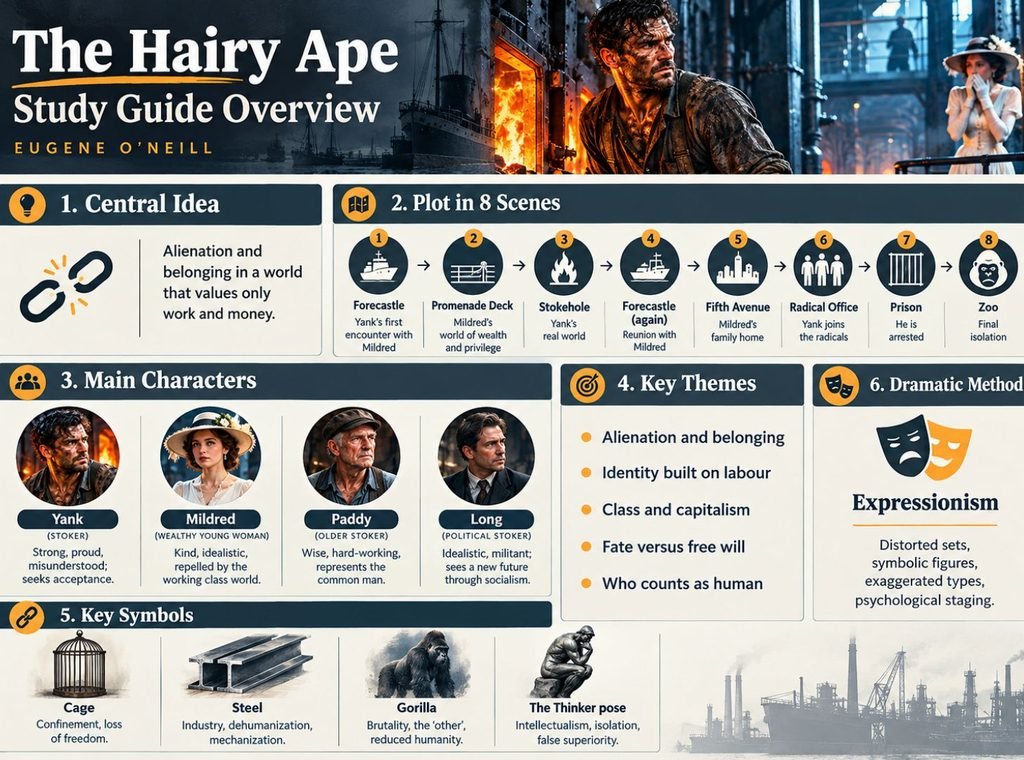
Plot Summary: The Hairy Ape Scene by Scene
O’Neill skipped the traditional act structure for The Hairy Ape. Instead, he hammered out eight episodic scenes, driving Yank through a rapid, jarring collapse. The jagged pacing mirrors the disorientation of psychological trauma—it hits in violent bursts rather than a smooth slide.
The play opens inside the firemen’s forecastle. O’Neill builds a literal cage on stage before any line is spoken, stacking bunks like raw steel framing. Yank reigns over this space. He is physical, loud, and convinced he is the literal motor of modern industry:
“I’m de ting in coal dat makes it boin; I’m steam and oil for de engines; I’m de ting in noise dat makes yuh deaf, yuh get me? Dat’s me, de new dat’s moiderin de old!”
It sounds like pure bluster, but it doubles as his core ontology: existence equals industrial production. Paddy, an older Irish stoker, undercuts this ego trip by mourning the age of sail, when sailors actually belonged to the sea. Long tries pushing socialist solidarity and gets immediately shut down. Both men map out the exact failures awaiting Yank downstream.
Scene Two shifts up to the sunlit promenade deck. Mildred Douglas, daughter to a steel titan, tells her aunt she wants to view “the other half” out of a mix of boredom and performative guilt. Her aunt dismisses it as morbid curiosity. The scene shifts away from the stokehole to emphasize the social distance between Mildred and the stokers. He wants the spatial separation to sink in—a single deck of cold steel dividing two entirely separate worlds—before slamming them together.
Scene Three is the structural hinge. The stokehole turns into a literal hellscape of heat, clanging metal, and soot-covered men shoveling coal. Yank is at his absolute peak, leading the crew in a labor rhythm, when Mildred steps down in a pristine white dress that immediately takes on coal dust. She catches Yank mid-roar, shrinks back, and gasps, “Oh, the filthy beast!” She faints immediately after seeing him. Four short words shatter Yank’s entire self-image. The rest of the play is just the fallout.
Scene Four returns to the forecastle. The roaring stops. O’Neill places Yank in the pose of Rodin’s The Thinker. Since Rodin originally sculpted that figure sitting right above The Gates of Hell, the staging lands with heavy irony: Yank isn’t engaging in high philosophy, he’s processing damnation. Long’s political language cannot accommodate Yank’s immediate, physical anger. He just wants to find Mildred’s father and smash something.
Scene Five drops Yank and Long onto Fifth Avenue, where expressionism takes over. Wealthy pedestrians move like clockwork, tossing out non-sequiturs about golf or corporate stock, stepping right through Yank like a ghost. Yank attempts to confront the pedestrians physically, but they ignore him. Nobody even notices. It’s a brutal rendering of class dominance: raw physical mass means nothing against an upper class that simply refuses to acknowledge your existence.
Scene Six finds Yank at an IWW storefront. He looks for comrades, but the local union organizer assumes he’s a government informant sent to sabotage them. When Yank proposes blowing up steel mills, they throw him out into the street. The political group rejects him, while the wealthy characters treat him as an object rather than a person. He belongs nowhere.
Scene Seven moves to a prison cell. A fellow prisoner reads a newspaper report quoting Mildred’s father, who compares union agitators to wild animals needing cages. Triggered by the language, Yank bends the iron cell bars in a frenzy. The display of power accomplishes nothing. He remains trapped, now facing extra property charges. The cage motif comes full circle.
Scene Eight ends at the zoo. Yank approaches the gorilla cage. In a bizarre, almost gentle exchange, he talks to the animal as an equal:
“Sure, you’re some hard-boiled guy, ain’t you? … Big guy nuts about a dame, goes N.G. wid a coupla drinks in him.”
He decides they share the same plight, unlocks the cage door in a moment of misguided brotherhood, and gets crushed as the gorilla wraps him in a lethal embrace. O’Neill gives Yank his final sense of belonging: crushed inside a cage, mistaking violence for connection.
The Shape of the Fall
Map that plot onto classical dramatic structure and you instantly see how tightly O’Neill builds it, even without formal act breaks. Scene One acts as exposition. It establishes Yank’s raw, unrefined worldview while setting up Paddy and Long as the two paths he refuses to walk—nostalgia on one side, political ideology on the other.
The rising action tracks a steady, terrifying narrowing. Yank starts as a king in the stokehole. Then Mildred looks at him. By Scene Five he’s completely invisible on Fifth Avenue. By Scene Six the IWW throws him into the street. Scene Seven locks him in a literal prison cell. Every single step shuts down another potential identity until there is nowhere left to turn.
The climax in Scene Eight isn’t a dramatic fistfight against high society. It’s just Yank staring into a gorilla’s cage, recognizing himself in an animal, and finding that realization fatal.
Falling action? O’Neill barely bothers. Yank dies, the stage directions give him a few harsh lines, and the gorilla beats its chest before shuffling back into the shadows. The world doesn’t pause. Business carries on. That refusal to mourn is the resolution—no catharsis, no speech from a soapbox, just the industrial machine grinding forward exactly as it did before Yank drew breath.
Characters in The Hairy Ape: Yank, Mildred, Paddy, and Long
Several distinct conflicts overlap here, and a serious analysis needs to pull them apart. The most obvious is Yank versus Mildred. That clash looks like a simple personal grudge, but it quickly shifts into man against an entire economic system. Yank isn’t just mad at a rich girl; he’s trapped in a class structure that produced her blind privilege and his backbreaking labor in the very same breath.
Beneath that lies the real engine of the play: man versus himself. Yank spends seven scenes spiraling over a single insult, trying to figure out what he is if he isn’t just the iron machine he thought he was.
O’Neill even twists the classic man-versus-nature dynamic. Yank doesn’t fight the natural world. He tries to join it, and it crushes him anyway.
The mechanics are worth tracking. Mildred’s line drops the spark. Every scene that follows shows Yank testing a new answer to being called a beast. He gets ignored, thrown out, and locked up. Repeated failure makes the ending feel like a trap closing, not a random twist.
Yank: A Man Made Entirely of What He Does
Yank Smith is impossible to look away from, not because he’s sympathetic, but because his collapse is so transparent. He begins the play utterly sure of his place. “I’m de ting in coal dat makes it boin,” he brags, and he means it literally. Function is his whole existence. He doesn’t have a private self hidden under his work clothes; when Mildred strips away the meaning of his job, he has no inner life to fall back on. That’s the real trap. His tragedy isn’t just that he suffers, but that he lacks the vocabulary or identity to process that suffering once his utility is gone.
He is also severely inarticulate. O’Neill writes his lines in heavy phonetic dialect—“boin” for burn, “moiderin” for murdering—and that spellwork isn’t just local color. It’s a wall. Yank feels an existential crisis with total violence and cannot put a name to it. He can only roar, smash things, or talk to a caged ape.
“The gorilla becomes the only figure to whom Yank speaks without anticipating social judgment.”
When analyzing Yank, avoid flattening him into a pure victim or a pure brute. He’s both: a man with genuine pride in his physical power, destroyed by a world that has no use for his humanity.
Mildred: Victim and Instrument at Once
Mildred Douglas destroys Yank’s sense of self in roughly four minutes of stage time, then vanishes from the play entirely. O’Neill doesn’t need her to be a fully fleshed-out human to make her structural impact land. She is twenty, aimless, and doing “social work” partly out of vague guilt over her father’s steel fortune and partly out of sheer boredom.
Her aunt calls her trip to the stokehole “morbid,” which hits the mark. When Mildred recoils and calls Yank a “filthy beast,” O’Neill marks the moment as terror, not calculated cruelty. She isn’t trying to destroy him; she simply cannot perceive him as anything other than a monster. That casual obliviousness is the point: a social hierarchy can crush a human life without anyone involved intending to harm.
She carries her own cage, too, even if it’s lined with silk: inherited wealth, a judgmental aunt, and a father whose steel mills fund her life while remaining completely abstract to her. Painting her as a pure villain misses the mechanics of the play, but treating her as a fellow victim excuses the damage she inflicts. Both reality points exist at once.
Paddy and Long: The Two Roads Yank Won’t Take
O’Neill introduces two distinct foils in Scene One, each offering a survival strategy Yank ultimately rejects.
- Paddy (Nostalgia): The old Irish stoker longs for the era of wooden sailing ships, where men wrestled with wind and sea instead of shoveling coal into steel furnaces. His speeches carry a lyrical, romantic rhythm—full of “clean skins” and “singing wind”—that clashes hard against Yank’s blunt dialect. Paddy represents a backward path toward an idealized past that no longer exists.
- Long (Ideology): The English stoker offers a path forward through political theory, class consciousness, and union organizing. But his socialist rhetoric—loaded with words like “capital” and “bourgeoisie”—sounds like empty noise to Yank. Yank needs a physical target he can punch with his fists, not an abstract economic system he has to analyze.
Long fails to reach Yank because Yank lacks the tools to turn political theory into physical action.
How O’Neill Builds His Characters
O’Neill uses four distinct structural techniques to build characterization on stage:
- Dialect and Diction: Word choices carry psychological weight before any action occurs. Yank’s aggressive phonetics, Paddy’s lyrical cadence, Long’s political jargon, and Mildred’s rigid, formal phrasing immediately mark their social boundaries.
- Physical Gesture: Physical movement carries narrative load. Yank flexes, brawls, and physically strains against steel; Mildred faints and shrinks back in disgust.
- Aggressive Stage Directions: O’Neill uses explicit stage notes to shape the environment, explicitly calling for forecastle bunks that look like animal cages and Fifth Avenue crowds that wear literal masks.
- The Soliloquy to the Ape: The monologue in Scene Eight gives Yank his only space to speak without judgment, serving as his most direct emotional disclosure in the entire text
Themes in The Hairy Ape: Alienation, Class, and Identity
Every theme in The Hairy Ape eventually circles back to one question. O’Neill is direct enough about it that he named an early draft The Story of a Man Who Was Struck Loose from His Native Universe. Alienation isn’t just a mood here; it’s the whole plot. Yank believes he belongs in the stokehole. Mildred’s line destroys that belief instantly. Every scene afterward tests a new candidate: the wealthy, organized labor, even the animal kingdom. None work. O’Neill‘s argument—made through structure rather than through any character’s speech—is that this isn’t Yank’s personal failing. It’s what an industrial economy does to anyone whose entire worth is defined by their labor. Once that labor stops mattering to you personally, or you’re told it never made you human to begin with, there’s no fallback self waiting underneath.
That leads directly into a second theme: identity built entirely on function. Yank’s opening boast, “I’m de ting in coal dat makes it boin,” is a definition of selfhood with zero remainder. He is what he produces, full stop. That’s fine as long as the world agrees to value what he produces. The instant Mildred refuses that valuation, Yank isn’t just insulted; he’s ontologically homeless. Compare this to Long’s political identity, which survives contact with defeat—he keeps organizing after Yank rejects him—or Paddy’s identity, rooted in memory rather than present function. Paddy can mourn the age of sail forever without needing anyone’s validation. Yank has neither a future project nor a past to retreat into. He only has a present that just got yanked out from under him.
Class and capitalism structure the entire physical world of the play. Literally. The sunlit deck sits above the infernal stokehole. Mildred’s father’s steel builds the ship’s engines, the prison bars, and the zoo cage alike. O’Neill doesn’t offer a political fix, notably. Long’s socialism reads as sincere but powerless, and the IWW office feels bureaucratic rather than revolutionary. The critique lands anyway, precisely because O’Neill refuses to pretend a pamphlet could solve what he’s describing.
Fate versus free will runs quietly underneath all of this. Yank tries, repeatedly, to act: confronting the rich, seeking the union, breaking his cell bars. Every attempt fails in exactly the way the play’s structure has been telegraphing since Scene One. O’Neill isn’t arguing that free will doesn’t exist. He’s arguing that a man born into Yank’s exact position has so narrow a range of real choices that his exercises of will look, from a wider angle, indistinguishable from fate.
Finally, consider the reversal of who counts as human. By Scene Eight, the gorilla is arguably the most sympathetic figure left in the play—caged through no fault of its own, killed almost accidentally, and more honest in its violence than any human Yank has met. O’Neill is suggesting, without ever stating it outright, that industrial modernity has inverted a hierarchy we take for granted. The animals are more free, and the people are more caged.
Symbols and Imagery in The Hairy Ape: Cages, Steel, and the Gorilla
The cage is the play’s most persistent image, and O’Neill builds it into the architecture before a single line of dialogue announces it: the forecastle bunks, the stokehole, the Fifth Avenue crowd’s rigid social choreography, the prison bars, and the zoo. Every setting confines him. The progression from metaphorical cage to literal cage tracks his diminishing room to maneuver.
Steel carries the play’s central irony. Yank identifies with it completely—”I’m what makes iron into steel”—but the play makes clear that steel is also what imprisons him. Mildred’s father’s fortune, the ship’s engines, the prison bars, and the zoo cage bars are all the same material. Yank thinks he is steel. He’s actually held by it.
The gorilla works as Yank’s mirror rather than his opposite. Both are strong, caged, and treated as less than fully human by the people around them. When Yank calls the ape a fellow member of “de same club,” he isn’t being naive. He’s making the most accurate diagnosis of his own situation in the entire play. The fatal embrace that follows reads almost like a kind of suicide by proxy: Yank is destroyed by the exact creature he’s chosen as a mirror.
The Thinker pose in Scene Four rewards knowing a little art history. Rodin‘s The Thinker was designed as part of The Gates of Hell, a monument to Dante’s Inferno. When O’Neill puts Yank in that exact silhouette, he isn’t suggesting Yank has suddenly become a philosopher. He’s suggesting Yank has started his descent, and that his “thinking” is really the first stirrings of despair rather than reason.
The Big Questions Underneath the Plot
Strip away the plot and The Hairy Ape asks a handful of blunt questions you should be ready to engage with directly in an essay, not just gesture at. What makes someone human, if not some essential inner spark, but instead a sense of belonging to other people? What happens to a person the moment that belonging is withdrawn? Is there any way out of a system like the one O’Neill depicts, or does every exit turn out to be another closed door?
And morally: is Mildred guilty of anything, given that her cruelty is unintentional? O’Neill seems to answer that indifference does damage regardless of intention—that the wealthy on Fifth Avenue don’t need malice to erase Yank, only a refusal to look at him. Philosophically, Yank anticipates the absurdist hero decades before Camus gave the type a name: a man confronting a universe that offers no ready-made meaning, finding, in the end, that the search itself was all he had.
Listening to How the Characters Talk
Pay close attention to diction. O’Neill differentiates his characters almost entirely through how they speak before you even factor in what they say. Yank talks in blunt, phonetically rendered fragments—“I’m de ting in coal dat makes it boin”—that mirror his limited vocabulary and his all-body, no-abstraction way of experiencing the world. Paddy’s speech runs long and lyrical, thick with sensory memory of wind and salt water. It’s the voice of a man who still has a past worth grieving. Long’s diction is the most “educated” of the three stokers, loaded with terms like “capital” and “exploitation” that mark him as politically literate—and, not coincidentally, as someone Yank can never quite understand. Mildred speaks in complete, grammatically correct sentences that reveal an almost total absence of self-knowledge. She wants to “do good” without any idea what that would require of her.
The Toolkit: Metaphor, Irony, Foreshadowing, Symbol
The play’s controlling metaphor is the ape itself. Yank starts as a man and ends having accepted an animal’s identity. O’Neill uses that slide to argue that industrial labor strips workers of exactly the qualities—reason, self-determination—that supposedly separate humans from animals.
Irony saturates the piece from its subtitle onward. Nothing about a man crushed to death by a gorilla he tried to befriend is comic, and that gap between the promised “comedy” and the delivered tragedy is the point. Foreshadowing works through the cage motif, present from line one and made literal by the final scene. You’re never allowed to forget where this is heading. Symbolism runs through nearly every object: the ship as modern civilization in miniature, the stokehole as hell, and the zoo as the terminus of an inverted hierarchy.
Expressionism and Stagecraft in The Hairy Ape
The opening scene is loud and almost comic—a bunch of drunk firemen brawling and boasting. That crude physical vitality makes Yank’s confidence brief and infectious. But Mildred’s visit in Scene Three flips a switch that never gets flipped back. The tone turns bleaker, more clipped, and desperate with every scene that follows. Fifth Avenue in Scene Five feels nightmarish, almost hallucinatory. Scene Seven’s prison is claustrophobic in a way the cramped forecastle never managed, simply because Yank now realizes he’s trapped. By Scene Eight, O’Neill has stripped the mood down to something close to a dirge. The early scenes look outward at Yank’s world; the later ones look inward at what’s left of him when that world stops answering.
How the Play Is Built for the Stage
The eight-scene structure gives the play an episodic, cinematic rhythm rather than relying on conventional acts. Each scene acts as a discrete stop on a journey—running from ship to avenue, then to the union office, prison, and finally the zoo. It’s a geography that doubles as a psychological map. O’Neill uses soliloquy sparingly. When he finally uses it in Yank’s monologue to the gorilla, it lands as the emotional peak precisely because it’s so rare.
His stage directions do interpretive work you’d normally expect from a critic, not a playwright. He tells you outright that the forecastle “is a cage,” that the stokehole should feel like Dante’s inferno, and that the Fifth Avenue crowd should look masked. Meanwhile, his handling of time is expressionistic instead of realistic. Weeks compress into a handful of scenes. Settings like Fifth Avenue tip from realism into near-hallucination to mirror Yank’s fracturing mind.
The World Outside the Theatre
Set the play against its historical moment and its choices sharpen. The 1920s were, on the surface, the Jazz Age—flappers, speakeasies, and a stock market that seemed only to climb. Underneath sat the wreckage of the Red Scare, an IWW gutted by prosecution, and a widening gap between industrial fortunes and the men who built them. O’Neill wrote Yank’s failed Fifth Avenue confrontation and his failed attempt at IWW solidarity as two sides of the same argument: neither the capitalist class nor the organized left had any place, in 1922, for a man like Yank.
The play also picked a fight with American theatre’s habits. Broadway in 1922 ran heavily toward drawing-room comedies and tidy melodrama. O’Neill brought a half-naked coal stoker and his crude dialect onto a stage accustomed to parlors, and critics noticed the collision immediately.
Its reception split along those exact fault lines:
- Audiences & Select Reviewers: Found it electrifying.
- Labor Groups: Embraced it as a genuine indictment of industrial capitalism.
- Traditional Critics: Found its unrelenting bleakness unbearable.
The play’s afterlife has been steady rather than spectacular. A 1944 film starring William Bendix and Susan Hayward smoothed over much of its harshness for wartime audiences. Decades later, the Wooster Group’s celebrated 1997 revival proved the play could still unsettle audiences three-quarters of a century after its premiere.
Critical Approaches to The Hairy Ape
You don’t need to pick a single critical school when writing about The Hairy Ape. Still, you should recognize the major angles and name real critics instead of vaguely gesturing at “some scholars.”
Marxist critics view Yank as the quintessential exploited worker. His alienation from his own labor is the direct, inevitable product of industrial capitalism, meaning his death is just the system disposing of a part it no longer needs.
Existentialist readings shift the frame. They treat Yank as a man confronting a universe devoid of built-in meaning, searching for purpose in a world that offers none and finding only the search itself as a kind of answer.
Psychoanalytic critics, working from Freud, offer a different angle entirely:
- The Stokehole Scene: Read as a primal scene of shame that Yank’s psyche never metabolizes.
- The Downward Spiral: Framed less as a social protest than as unprocessed, interior trauma.
Feminist criticism turns the lens on Mildred, reading her as simultaneously victim and instrument of a patriarchal, class-bound system that trains her to see workers as specimens rather than people.
In The Haunted Heroes of Eugene O’Neill, Edwin Engel argued that Yank enjoys only a false sense of belonging even at his most confident—a reading that anticipated the alienation studies that later dominated O’Neill scholarship. Recent work has taken a zoocritical turn. Scholars like Anca Peiu examine the gorilla not as mere metaphor, but as a figure of genuine otherness that exposes the limits of human self-understanding. John Nickel‘s 1998 essay in The Eugene O’Neill Review pushes further still. He argues that the play’s ape imagery is deeply entangled with the racial pseudoscience of its era. It’s a critical reading worth sitting with if you want to complicate the standard Marxist account.
He is what he does, and what he does matters, until the world decides it no longer does.
— On Yank’s crisis of function
My Own Reading
I find The Hairy Ape hardest to shake precisely because O’Neill refuses you any comfort at the end. He refuses to let Yank’s struggle collapse into pure pathos, either. Yank keeps fighting long after fighting has stopped making sense—on Fifth Avenue, in the union office, and against his own cell bars. There’s something close to dignity in that refusal, even though every attempt fails.
O’Neill isn’t arguing that struggle redeems anyone. He’s arguing that struggle is simply what a person does when the alternative is admitting you’ve already lost. Yank’s tragedy is inseparable from his stubbornness.
A purely despairing reading overlooks Yank’s persistence; a purely heroic reading overlooks the structural forces that limit his choices.The tension between them is exactly what keeps the play alive in a classroom a century after it opened.
Studying the Text: Where to Look Closely
When you sit down with specific scenes, here’s where the real analytical payoff is hiding.
1. Track Yank’s language across the play. Count how often he uses “I” versus “we” in Scene One compared to Scene Eight. His grammar of selfhood collapses along with everything else, and that collapse is visible on the page, not just in the plot.
2. Read the stage directions as argument, not decoration. When O’Neill tells you the forecastle looks like a cage or that the Fifth Avenue crowd wears masks, he’s making a critical claim before any character opens their mouth. Quote the stage directions in your essays; they carry as much interpretive weight as dialogue.
3. Follow the Rodin reference all the way through. Look up an image of The Thinker and note its original placement above The Gates of Hell. Then reread Scene Four with that context. The irony only lands if you know what the pose is quoting.
4. Compare Paddy’s and Long’s speech patterns line by line. Circle every abstract noun in Long’s dialogue and every concrete, sensory image in Paddy’s. That contrast is doing the play’s thematic work for it: memory versus ideology, both losing to Yank’s raw present-tense rage.
5. Watch what happens to the word “belong.” O’Neill repeats it relentlessly, from Yank’s confidence in Scene One to his dying realization in Scene Eight. Track every instance and you’ll have a ready-made argument about how the play’s central word changes meaning as Yank’s understanding of himself falls apart.
Exam-Style Questions on The Hairy Ape
1. O’Neill subtitled the play “A Comedy of Ancient and Modern Life in Eight Scenes.” Using specific moments from at least three scenes, argue for or against reading the play as a comedy in any meaningful sense.
2. Trace the cage motif from the forecastle bunks in Scene One to the zoo cage in Scene Eight. What does the shift from metaphorical to literal cages tell you about Yank’s arc?
3. Compare Paddy and Long as foils to Yank. Why does O’Neill make sure both men fail to redirect Yank’s rage, and what does that double failure suggest about the play’s view of both nostalgia and political ideology as answers to alienation?
4. Mildred Douglas appears in only two scenes. Analyze how O’Neill builds her into a fully functioning symbol of class obliviousness with so little stage time, using specific lines and stage directions.
5. “He belongs,” O’Neill’s stage direction tells us as Yank dies. Is this irony, tragedy, or something else? Defend your reading with evidence from the final scene.
6. Explain how O’Neill’s Expressionist techniques—distorted settings, masked figures, and exaggerated types—serve the play’s psychological argument rather than merely its visual style.
Further Reading
• Bogard, Travis. Contour in Time: The Plays of Eugene O’Neill. Oxford University Press, 1988. The standard critical survey of O’Neill’s dramatic development; situates The Hairy Ape within his broader turn toward Expressionism.
• Engel, Edwin A. The Haunted Heroes of Eugene O’Neill. Harvard University Press, 1953. An early, still-influential study of O’Neill’s tragic protagonists, including a sharp reading of Yank’s collapsed sense of belonging.
• Nickel, John. “Racial Degeneration and The Hairy Ape.” The Eugene O’Neill Review 22.1/2 (1998): 33-40. Reads the play’s ape imagery through the lens of early twentieth-century racial pseudoscience.
• Peiu, Anca. “Eulogy of the Ape: Paradigms of Alterity and Identity in Eugene O’Neill’s The Hairy Ape.” Available via Project MUSE. Explores the play’s visual art references, including the Rodin allusion, and its treatment of otherness.
• eOneill.com Study Companion, curated by Margaret Loftus Ranald and the Eugene O’Neill Society. Production history, archival photographs, and contemporary reviews from the original 1922 run.
• EBSCO Research Starters, “The Hairy Ape: Analysis of Setting” and related entries. Useful for quick, reliable fact-checking on production history and setting.
• O’Neill, Eugene. The Hairy Ape, in Complete Plays 1920-1931, edited by Travis Bogard. Library of America, 1988. The most reliable scholarly edition of the text itself; cite this edition, not an uncredited online transcript, in formal essays.
Whatever edition you read from, read the stage directions as carefully as the dialogue. O’Neill wrote them to be studied, not skipped.

Author: mkalam
Educator and content creator