

A Complete Student Guide to Dryden’s Absalom and Achitophel: Context, Allegory, Heroic Couplets, and Political Satire
Absalom and Achitophel: Introduction
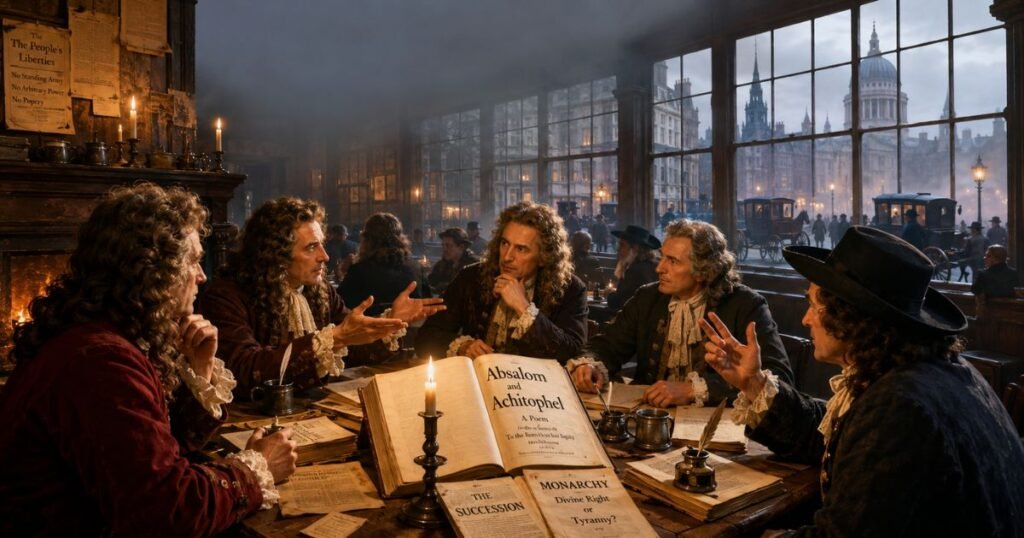
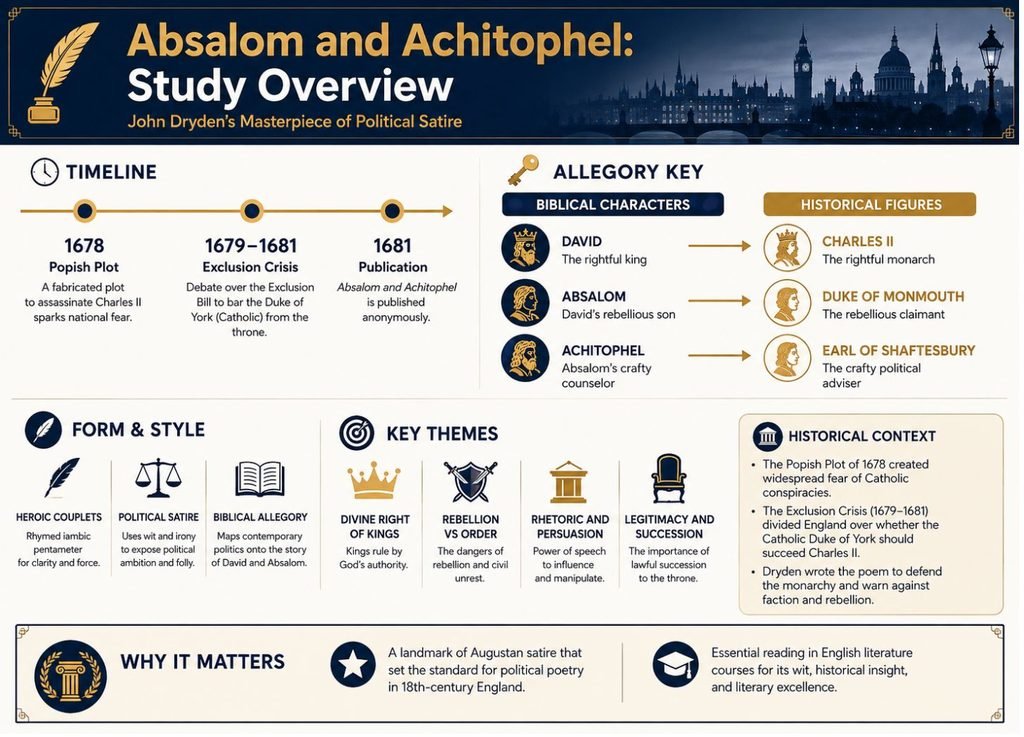
In 1681, London booksellers began selling an anonymous poem about a biblical rebellion. Its title named Absalom, the beautiful son who rebels against King David, and Achitophel, the counselor who persuades him to do so. London readers quickly recognized the political identities beneath the biblical names. Absalom represented James Scott, Duke of Monmouth, Charles II’s Protestant but illegitimate son; Achitophel represented Anthony Ashley Cooper, first Earl of Shaftesbury, the Whig leader who opposed the succession of Charles’s Catholic brother, James, Duke of York. The poem was John Dryden’s Absalom and Achitophel, a work that transformed a contemporary political crisis into one of the most accomplished examples of Restoration satire.
- Absalom and Achitophel: Introduction
- The Crisis Behind Absalom and Achitophel
- Why Dryden Uses Biblical Allegory in Absalom and Achitophel
- John Dryden and the Occasion of Absalom and Achitophel
- Voice and Tone in Absalom and Achitophel
- Structure and Movement in Absalom and Achitophel
- Genre: Satire and Epic in Absalom and Achitophel
- The Discipline of the Heroic Couplet
- Characters, Symbols, and Allegory in Absalom and Achitophel
- Political Argument in Absalom and Achitophel
- Tensions and Contradictions in Absalom and Achitophel
- Absalom and Achitophel in Literary History
- Conclusion: Why Absalom and Achitophel Still Matters
Dryden’s subject is not simply the biblical story of David and Absalom. He examines how political rhetoric turns grievance into rebellion, how popularity can be mistaken for legitimacy, and how a gifted speaker can make self-interest sound like public duty. He builds this argument through biblical allegory, dramatic character portraits, and tightly controlled heroic couplets. The result is both a royalist defense of hereditary monarchy and a sophisticated study of political persuasion.
The Crisis Behind Absalom and Achitophel
Understanding the poem means understanding the panic that produced it. In 1678 Titus Oates, a disgraced clergyman with a talent for invention, alleged a Catholic conspiracy to assassinate Charles II and place his Catholic brother James on the throne. The so-called Popish Plot had no real evidence behind it, but England had spent much of the seventeenth century fighting over religion, and the accusation caught immediately. Dozens of Catholics were tried and executed before the fabrication came apart.
Shaftesbury and the parliamentary faction that became known as the Whigs used the resulting hysteria to push the Exclusion Bill, which sought to bar James, Duke of York, from the succession because his Roman Catholicism raised fears about the future of England’s Protestant and constitutional settlement. Between 1679 and 1681, three Parliaments met during the Exclusion Crisis, but none succeeded in excluding James, Duke of York, from the succession.
Charles had seen his father executed during the Civil Wars and had spent years in exile before returning in 1660. He therefore resisted Parliament’s attempt to determine the succession.He dissolved each Exclusion Parliament in turn, and by 1681 the political temperature in London had reached a point where either side might have resorted to arms.
Shaftesbury’s preferred alternative to James was the Duke of Monmouth, Charles’s eldest illegitimate son, a Protestant and, by most accounts, a genuinely charming young man with a talent for making himself loved by crowds. He had no legal claim to the throne. Charles had no legitimate surviving children. Monmouth’s supporters therefore needed either a change in the succession law or the unsubstantiated claim that Charles had secretly married his mother, Lucy Walter. Dryden wrote the poem while Shaftesbury was imprisoned in the Tower on a charge of high treason. In November 1681, a London grand jury rejected the indictment, a decision that exposed the depth of the political conflict surrounding the case. Dryden recasts a constitutional dispute as a moral and spiritual failure. In his version, the conflict is not primarily about succession law; it is a rebellion against divinely sanctioned order.
Why Dryden Uses Biblical Allegory in Absalom and Achitophel
Dryden did not invent the comparison between Charles II and King David. English writers had used it since the Restoration, mostly without irony, because the parallels were genuinely close. Both men returned from years of exile to reclaim a throne their family had lost. Both were known for keeping mistresses and fathering children outside marriage. Both faced rebellion from a son. By 1681 the David comparison was a familiar piece of royalist rhetoric, and Dryden‘s readers would have recognized it before they reached his opening couplet.
What Dryden added was the specific pairing named in his title. Absalom, in 2 Samuel 13 to 18, is David’s favored son, admired for his beauty and popularity, who rebels against his father at the urging of Achitophel, David’s own counselor turned traitor. The parallel to Monmouth and Shaftesbury is close enough to be exact rather than merely suggestive: an illegitimate son with genuine public affection behind him, guided by an older, cannier political operator with grievances of his own. This story served several purposes. It let him defend Monmouth’s character even while condemning his actions, since the biblical Absalom is presented as both a wronged son and a rebellious claimant, a mixture that allowed Dryden to condemn his actions while preserving his personal appeal. It let him place the entire weight of calculation and malice onto Achitophel, sparing the king’s son the full force of satire while destroying the reputation of Shaftesbury. And it let him frame a live political dispute inside a narrative his readers already knew ended in the rebel’s death and the father’s grief, so that the poem’s outcome felt preordained before Dryden had written a word of it.
John Dryden and the Occasion of Absalom and Achitophel
A contemporary tradition holds that Charles II suggested the subject to Dryden. Whether or not the king made the request directly, the poem was written within a political culture in which royal authority, patronage, and literary production were closely connected. Dryden was well placed to respond. Born in 1631 in Northamptonshire to a family with Puritan and parliamentarian sympathies, he was educated at Westminster School under the formidable Richard Busby and then at Trinity College, Cambridge. He had spent the previous two decades establishing himself as the dominant literary figure of his generation: playwright, translator, critic, and, since 1668, England’s first official Poet Laureate. His political and religious loyalties were not fixed points. He had written an elegy for Cromwell in 1659 and a poem celebrating the Restoration a year later; he wrote Absalom and Achitophel as a defender of the Anglican settlement in 1681. He converted to Roman Catholicism in 1685. After the Revolution of 1688, he lost the laureateship because he refused to swear the oaths of allegiance to William and Mary. None of this makes him a cynic. It makes him a working writer navigating four decades of the most unstable political ground in English history, and it explains why he brought such craft to the task of making one side of an argument sound inevitable.
Voice and Tone in Absalom and Achitophel
Dryden’s narrator speaks as though standing above the fray, offering judgment with the confidence of an eyewitness to divine order. That confidence is a performance. The poem is unapologetically partisan, and Dryden says so openly in his prose preface, “To the Reader,” where he admits that he who draws his pen for one party must expect to make enemies of the other. The poem presents its partisan judgments in the language of moral certainty. He sounds like someone stating obvious facts.
That voice shifts register by subject with striking control. Describing David, it rises toward reverence: Charles appears repeatedly as “godlike David,” a phrase Dryden uses to make the king’s authority sound like a fact of nature rather than a political arrangement. Describing Achitophel, the same voice turns cold and precise, listing faults like prosecutor listing evidence:
“For close designs, and crooked counsels fit;
Sagacious, bold, and turbulent of wit.”
The contrast makes David appear morally stable and Achitophel intellectually dangerous. A narrator who praised David and simply insulted Achitophel would read as a hired pen. A narrator who anatomizes Achitophel’s psychology with this kind of clinical attention reads as a moralist diagnosing a disease, which is exactly the effect Dryden wants: the poem repeatedly figures the nation as a body and rebellion as an infection, so a narrator who examines Achitophel like a physician examining a symptom reinforces the poem’s central metaphor without ever stating it directly.
Structure and Movement in Absalom and Achitophel
The poem is a continuous sequence of heroic couplets, running to more than 1,000 lines without formal cantos or stanza divisions. It gives the poem the forward drive of an unfolding argument instead of the pauses and resets of a story told in installments.
The movement itself follows a recognizable shape. Dryden opens by establishing David’s secure and prosperous reign and Absalom’s popularity, then turns to the English temperament itself: a people he describes as naturally “headstrong” and prone to testing any authority placed over them, restrained for a time only by memory of the Civil War’s “wounds, dishonest to the sight.” Once that restraint weakens, Achitophel enters and begins his campaign on Absalom, flattering him as a “second Moses” destined to lead the people to a promised land only Absalom can provide. The temptation scene is the poem’s structural and thematic center: everything before it builds toward Absalom’s decision, and everything after traces its consequences. Dryden then widens the frame to a catalogue of Achitophel’s allies, a gallery of satirical portraits, including Zimri (the Duke of Buckingham) and Shimei, that exposes the rebel coalition as a collection of grudges and appetites rather than a coherent political movement. The poem closes with David’s own speech from the throne, a mixture of grief and resolve that reasserts royal authority and, within the fiction, ends the crisis.
The poem’s temptation scene recalls Paradise Lost, especially the way Milton presents persuasive evil as a form of argument. The resemblance encourages readers to see Achitophel as a political version of Milton’s Satan.
Genre: Satire and Epic in Absalom and Achitophel
Dryden resisted a single label for his own poem. The title page calls it simply “A Poem,” not a satire, and in “To the Reader” he distinguishes his method from Juvenal’s savage directness, aligning himself instead with the more urbane, indirect wit of Horace. Dryden describes some of the poem’s satirical portraits in a ‘Varronian’ manner, a mixed mode that combines several kinds of satire. The label helps explain the poem’s shifts between epic elevation, moral commentary, political attack, and comic caricature. That mixed satirical method also describes the poem’s larger design. It borrows the elevated diction, epic simile, and invocation of cosmic order proper to heroic verse, while using those tools for the pointed, individualized attacks proper to satire. The effect is a poem that asks to be read with the seriousness due to scripture and epic, even as it is doing the work of a political pamphlet.
The Discipline of the Heroic Couplet
The poem is written throughout in heroic couplets: rhymed pairs of iambic-pentameter lines. Dryden did not invent the form, but he brought it to a level of flexibility that later poets, Pope especially, would treat as the standard to match. Within the couplet’s fixed shape, he varies the placement of the caesura, lets sense run across line breaks when he wants momentum and stops it hard when he wants an epigram, and exploits the closing couplet’s natural tendency toward antithesis and balance.
Consider how the form serves the content in the portrait of Achitophel:
“In friendship false, implacable in hate:
Resolv’d to ruin or to rule the state.”
— Absalom and Achitophel, ll. 173–174
The couplet’s balance is the point. Two clauses, each occupying half a line, set against each other with the same weight, mimic Achitophel’s own reasoning, in which ruin and rule are equally acceptable outcomes because only power itself matters to him. The tight formal control mirrors the very quality Dryden accuses Achitophel of lacking: a stable, ordered relationship between means and ends. When the narrator later summarizes Achitophel’s worldview directly, the couplet again does the moral work of the line:
“Plots, true or false, are necessary things,
To raise up commonwealths, and ruin kings.”
The parallel structure of “true or false” and the matched infinitives “raise up” and “ruin” present two opposite outcomes as though they were interchangeable, which is precisely the moral confusion Dryden wants readers to notice and reject.
This is worth pausing on, because it is easy to treat the heroic couplet as a neutral container into which any content might be poured. Dryden uses it as an argument. Order in the verse stands for order in the state; a couplet that resolves cleanly enacts, in miniature, the resolution David eventually imposes on the rebellion. Even when characters speak treason, the form around their words stays composed, which quietly tells the reader that no amount of rhetorical skill can actually unsettle the underlying order the poem defends.
Characters, Symbols, and Allegory in Absalom and Achitophel
The poem’s biblical allegory is not decoration. It is the argument’s engine, and Dryden sustains it with remarkable consistency across more than a thousand lines. David stands for legitimate monarchy and divine sanction; the epithet “godlike David,” repeated across the poem, does the work of a constant refrain, reminding readers of the argument even in passages ostensibly about something else. Absalom represents dangerous charisma without malice: his beauty and popularity make him useful to Achitophel precisely because they make him beloved by a public that will follow him without asking hard questions. Achitophel himself is the poem’s most fully realized figure, a portrait of intelligence entirely unmoored from principle, and Dryden draws him with an eye clearly trained on Milton’s Satan: the same “fiery Soul” burning through an inadequate body, the same gift for making rebellion sound like liberty.
Two images recur with particular force. The “golden calf” Dryden uses to describe the state the crowd wants to construct for itself alludes to Exodus 32, where the Israelites melt down their gold into an idol the moment Moses is out of sight. Applied to Restoration politics, the image accuses the Whig coalition of idolatry: worshipping a government of their own making rather than submitting to authority ordained from above. The other is subtler and easy to misread. Describing the credulity with which Londoners accepted rumors of the Popish Plot, Dryden writes that the story was
“not weighed, or winnowed by the multitude;
But swallowed in the mass, unchewed and crude.”
Read quickly, “the mass” might suggest the Catholic Mass, given the poem’s religious subject matter, but the line’s actual target is intellectual, not doctrinal: it accuses the crowd of consuming a story without examining it, the way an animal bolts food without chewing. Although ‘mass’ primarily means an undifferentiated body or quantity here, the word may also carry a faint Catholic resonance in a passage about anti-Catholic panic. The poem’s central accusation, however, is that the crowd accepted the story without weighing its evidence.
Political Argument in Absalom and Achitophel
Strip away the biblical costume and the poem is making four connected arguments, each embodied in a relationship rather than stated as a thesis.
The first concerns temptation. Achitophel does not force Absalom into rebellion; he talks him into it, and the temptation speech is one of the poem’s technical high points, drawing directly on the debate in Hell in Paradise Lost. Achitophel calls Absalom a “second Moses” destined to lead the people to a “promised land,” flatters his virtues, and reframes treason as public service, all without ever making an argument Absalom could easily refute. The scene works because the seduction is genuinely persuasive. Readers can feel how a proud, popular young man might be moved by this rhetoric even while recognizing, as Dryden clearly wants them to, that Achitophel believes none of it.
The second concerns divine right. Dryden‘s David rules by an authority he did not invent and cannot legitimately be stripped of by a vote or a crowd, which is why rebellion against him counts, in the poem’s logic, as sin rather than mere political disagreement. The poem never argues this position through reasoned debate; it assumes it, and builds its emotional architecture- David’s suffering, his patience, his eventual thunder- around the assumption.
The third concerns factionalism versus stability. Dryden repeatedly figures the nation as a body, England’s political health as physical health, and faction as disease. Political moderation becomes, in this framework, not a weak compromise but the position of health itself, and Dryden says directly that he aims his poem at readers “in the middle,” hoping to pull them back from the edges rather than convert committed partisans on either side.
The fourth concerns legitimacy. Absalom’s charm cannot substitute for his birth. David’s speech near the poem’s close makes the genealogical point explicit, drawing the same distinction the poem has been drawing all along between a king who rules by right and a claimant who would rule only by popularity, which Dryden treats as a far less stable foundation for government.
These arguments give the poem its political direction, but they do not eliminate its contradictions. Dryden’s most effective writing often makes the opposing position more vivid than the royalist answer.
Tensions and Contradictions in Absalom and Achitophel
Read only for its politics, Absalom and Achitophel looks like a straightforward royalist argument. Read closely, it is more unsettled than that. Dryden does not hide Charles’s “vigorous warmth” or his taste for mistresses in the poem’s opening lines; he treats the king’s sexual license almost as comedy, which softens royal misconduct rather than concealing it, but which also means the poem’s own portrait of David includes exactly the moral untidiness the rest of the poem condemns in others. Some modern readers have found in this an unresolved tension: a poem that argues for order and legitimacy while opening with a king whose own household disorder helped create the succession crisis in the first place.
The Achitophel portrait raises a related question. Dryden gives his villain the poem’s most memorable lines and its most alert intelligence. Every reader remembers “In friendship false, implacable in hate” long after they have forgotten David’s speeches, and that is not an accident of bad writing. Dryden was too skilled a dramatist to make his antagonist dull, and the resulting portrait, like Milton‘s Satan before it, risks generating more admiration for its craft than the poem’s argument strictly wants. Whether that risk undermines the poem’s royalist case or simply demonstrates Dryden’s control over even his most dangerous material is a question critics continue to debate.
A further complication emerges once you know what came after the poem: its treatment of religion. Dryden was a practicing Protestant when he wrote Absalom and Achitophel, yet the poem treats Catholics largely as victims of a fabricated conspiracy rather than as the threat Oates’s supporters claimed. Four years later Dryden converted to Rome. The poem does not predict that conversion, but it shows a writer already skeptical of the anti-Catholic hysteria that had gripped the capital, which complicates any reading of the poem as simple partisan propaganda produced to order.
Absalom and Achitophel in Literary History
Dryden was not the first English poet to build a political allegory. Spenser had done it in The Faerie Queene nearly a century earlier. What separates Absalom and Achitophel from that tradition is its directness. Spenser‘s allegory operates at a remove, inviting rather than demanding identification between fiction and fact. Dryden‘s readers needed no key: within days, everyone in London knew which character stood for which living politician, and Dryden wrote knowing they would know.
The choice of form matters just as much as the choice of directness. Spenser worked in stanzas; Dryden chose the heroic couplet, a form whose compression and closure suit satire’s need for the memorable, quotable line far better than a stanzaic romance does. That choice had consequences beyond this one poem. The heroic couplet Dryden refined here became the dominant instrument of English verse for the next half-century, and Alexander Pope, who was thirteen years old when Dryden died in 1700, learned the form largely by studying poems like this one. Dryden’s refinement of the heroic couplet strongly influenced Pope and helped establish the couplet as the dominant vehicle of English satire and verse criticism during the eighteenth century.
Conclusion: Why Absalom and Achitophel Still Matters
Absalom and Achitophel remains valuable because its political argument and literary method do not completely coincide. Dryden defends hereditary monarchy and condemns attempts to alter the succession, yet he gives his opponents intelligence, persuasive language, and memorable personalities. Achitophel’s speeches are dangerous within the poem’s moral system because they sound reasonable before their consequences become visible.
Modern readers may reject Dryden’s theory of divinely sanctioned monarchy, but they can still study how the poem turns one political interpretation into an apparently inevitable judgment. Its allegory translates living politicians into biblical types; its satire makes motives visible through character; and its heroic couplets give political claims a memorable form. The poem endures because it shows, with unusual technical control, how literature can make political persuasion feel like moral truth.
Study Questions
- Dryden repeatedly associates Charles II with “godlike David.” Select three examples and explain how the epithet constructs royal authority.
- Compare Achitophel’s speech to Absalom with Satan’s rhetoric in Paradise Lost, especially Books 2 and 9. How does Dryden adapt Milton’s presentation of persuasive evil?
- The poem begins by treating David’s sexual conduct with comic indulgence. How does this treatment complicate Dryden’s later defense of order and legitimacy?
- Achitophel argues that “the people have a right supreme / To make their kings.” Why does Dryden place this argument in the mouth of a character whom readers are expected to distrust?
- Choose one heroic couplet from the poem. Analyze its rhyme, syntax, caesura, antithesis, and degree of closure.
- How does Dryden’s use of biblical names shape the reader’s judgment of Monmouth, Shaftesbury, and Charles II before the characters speak?
- Does the poem present Absalom as a villain, a victim, or a morally divided figure? Support your answer with close reference to the poem.
Further Reading and Related Texts
• John Milton, Paradise Lost (1667). The direct source for Dryden’s temptation scene and for Achitophel’s characterization as a Satan figure; reading Book 9 alongside Achitophel’s speech to Absalom makes the borrowing, and Dryden’s departures from it, immediately visible.
• Alexander Pope, The Rape of the Lock (1712) and The Dunciad (1728). The clearest demonstration of what the heroic couplet, refined in Absalom and Achitophel, could do once turned toward social rather than strictly political satire.
• Jonathan Swift, Gulliver’s Travels (1726). A later Augustan satirist working in prose rather than verse, useful for comparing how allegory functions differently across the two forms.
• Paul Hammond, John Dryden: A Literary Life (Palgrave Macmillan, 1991). A standard critical biography that places the poem within the full arc of Dryden’s shifting political and religious commitments.
• Steven N. Zwicker, Politics and Language in Dryden’s Poetry (Princeton University Press, 1984). A close study of how Dryden’s verse does political work, with sustained attention to Absalom and Achitophel.
• James Anderson Winn, John Dryden and His World (Yale University Press, 1987). A detailed biographical study useful for the historical context surrounding the poem’s composition and reception.

Author: mkalam
Educator and content creator