


A Complete Study Guide to Hawthorne’s “Young Goodman Brown”
Young Husband Walks Into a Forest
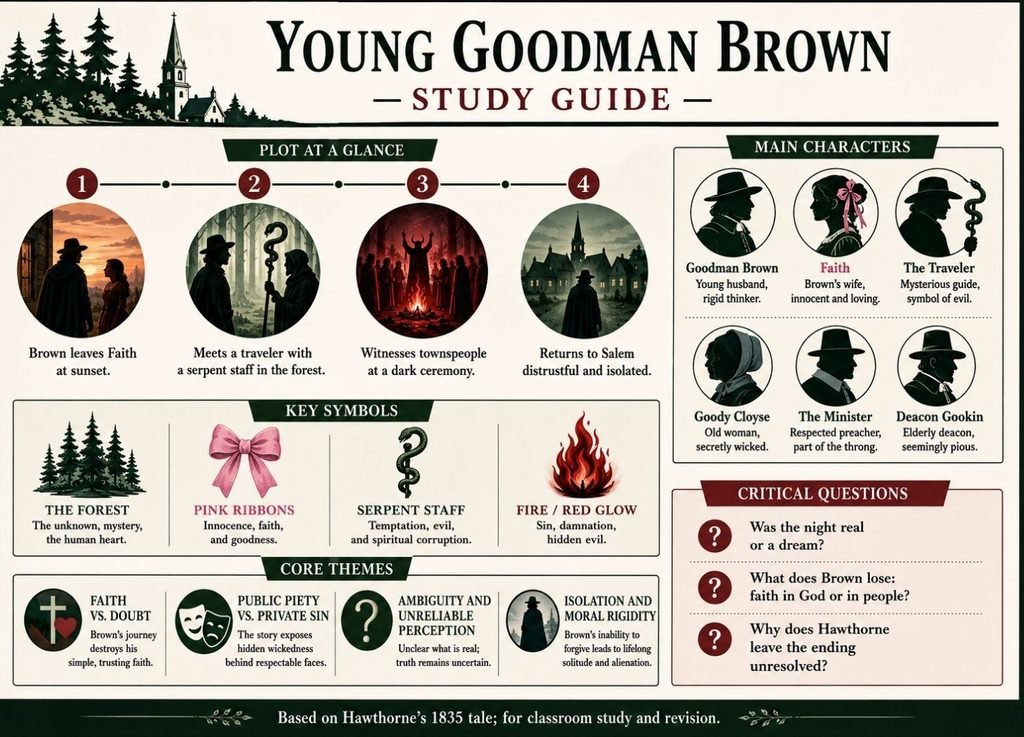
Goodman Brown leaves Salem at sunset for a journey he refuses to explain to his wife, Faith. By morning, he has seen—or believes he has seen—the corruption of everyone he once trusted. He returns home unable to distinguish between evidence and suspicion, and he spends the rest of his life in distrust.
- Young Husband Walks Into a Forest
- The Man Behind the Name
- Young Goodman Brown Study Guide: Plot Summary
- Young Goodman Brown Study Guide: Characters and Symbols
- Young Goodman Brown Study Guide: Themes and Meanings
- How Hawthorne Builds the Story
- Young Goodman Brown Study Guide: Critical Interpretations
- Young Goodman Brown Study Guide: Was It a Dream?
- Reading It Today
The plot is small: one night, one walk, and one damaged marriage. Hawthorne devotes little space to action. Instead, he follows Brown’s changing perceptions and asks what happens when a person treats uncertainty as proof. This guide examines the story’s plot, historical background, symbols, narrative techniques, and major critical interpretations.
The Man Behind the Name
Nathaniel Hawthorne was born in Salem, Massachusetts, on July 4, 1804. He grew up in the shadow of two ancestors he never met and could not put down. William Hathorne, his great-great-great-grandfather, arrived in Massachusetts in the 1630s and built a reputation as a magistrate who showed no patience for religious dissent. He ordered a Quaker woman publicly whipped through the streets of Salem. William’s son, John Hathorne, inherited both his father’s severity and his position on the bench. When the Salem witch trials opened in 1692, John Hathorne sat as one of the examining magistrates, and he pushed the accused toward confession rather than acquittal.
Hawthorne added the “w” to his surname as a young man, not long after college, and the change looks like an attempt at distance. It did not work, at least not on the page. In “The Custom-House,” the autobiographical sketch that opens The Scarlet Letter, he wrote directly to his ancestors, apologizing for their cruelty and asking, half seriously, that any curse attached to the family name be lifted from him. “Young Goodman Brown” carries that same weight. When the devil in the forest tells Brown that he helped “your grandfather, the constable” whip a Quaker woman through Salem’s streets, Hawthorne is folding his own great-great-grandfather into the story and compressing three generations into one word. In this passage, Hawthorne places his family history almost directly inside the fiction.
The story itself first appeared in the New-England Magazine in April 1835, printed anonymously and credited only to “the author of ‘The Gray Champion.'” Hawthorne collected it fifteen years later in Mosses from an Old Manse (1846), where it found its most important early reader: Herman Melville.
“It may be, however, that all this while, the book, like wine, was only improving in flavor and body.”
— Herman Melville, “Hawthorne and His Mosses” (1850)
Melville wrote those words about the Mosses collection as a whole, in an 1850 essay that did more than any other single piece of writing to establish Hawthorne’s reputation. But he singled out “Young Goodman Brown” by name as proof of what he called the “blackness” in Hawthorne, a darkness he found more honest and more interesting than the era’s taste for moral uplift. Melville was not being polite. He meant that the story gets better with rereading, and that judgment has held up for close to two hundred years.
What is the story about?
“Young Goodman Brown” is not simply a story about discovering that respectable people are sinful. It is a story about the damage caused by demanding certainty about other people’s inner lives. Brown sees signs, hears accusations, and experiences a terrifying ceremony, but he never receives evidence that can withstand examination. His tragedy lies in treating suspicion as knowledge and then using that uncertain knowledge to withdraw from human relationships.
Young Goodman Brown Study Guide: Plot Summary
Sunset in Salem
Brown and Faith have been married three months. Faith begs him to stay home, telling him she is “troubled with dreams” and afraid to be alone. Brown insists he must go, promising himself it is a single night’s errand and that afterward he will “cling to her skirts and follow her to heaven.” He leaves anyway, carrying a guilty conscience and a purpose Hawthorne never names outright.
The Fellow Traveler
In the forest, Brown meets a man who could be his own father, dressed plainly, carrying a staff carved to look like a black serpent. Hawthorne never calls him the devil. He does not need to. The traveler knows Brown’s family history, including the Quaker woman’s whipping. He also knows the private sins of Brown’s neighbors. Brown resists at first, insisting his people come from “a race of honest men and good Christians.” The traveler keeps walking, and keeps talking, and Brown keeps following.
Voices in the Dark
Goody Cloyse, the woman who taught Brown his catechism as a boy, passes through the forest muttering about broomsticks and devil’s ointment. Brown hides and watches, stunned. Further on, he hears the minister and Deacon Gookin ride past on horseback, discussing the night’s “communion” as though it were an ordinary church meeting. Brown clings to one last hope: if Faith is safe, he can still bear the rest. Then a black cloud crosses the sky, filled with voices he recognizes, and a pink ribbon flutters down out of it and catches on a branch. Brown cries out, “My Faith is gone!” and gives up.
The Communion at the Rock
Brown runs through the forest until he reaches a clearing lit by torches and a fire that turns the surrounding pines red. Every respectable face in Salem is there: the minister, the deacon, Goody Cloyse, men and women he has trusted his whole life, standing beside people known for open wickedness. The devil calls the new converts forward for baptism into “the mystery of sin.” Brown and Faith are led up together. In the last instant before contact, Brown shouts to her to look toward heaven and resist. What happens next is the one moment in the story Hawthorne refuses to describe. Brown finds himself alone, “amid calm night and solitude,” with no way to confirm whether Faith obeyed him or not.
Morning, and After
Brown walks back into Salem at dawn, and everything looks ordinary. Faith runs to meet him, wearing her pink ribbons, glad to see him home. Brown looks at her “with a stern, a sad, a darkly meditative, a distrustful” face, and passes her without a greeting. Hawthorne then jumps forward across the rest of Brown’s life in a few sentences. Brown never trusts anyone in Salem again, not his minister, not his neighbors, not his own wife. He dies old, friendless, and unmourned. The story never confirms whether the night was real, imagined, or deliberately left between those possibilities.
Young Goodman Brown Study Guide: Characters and Symbols
Goodman Brown
Brown enters the forest a young man who has never questioned his community’s goodness. He leaves it convinced that everyone he knows, himself excepted, is corrupt. Hawthorne builds him as a study in rigid thinking. Brown cannot hold two ideas about a person at once. Either Faith is pure or she is fallen. Either the minister is holy or he is a fraud. When the forest gives him evidence that will not sort cleanly into either box, he chooses the darker reading and never revisits it, even decades later when he might have had reason to doubt his own memory of that night.
His name carries the argument in miniature. “Young” marks the innocence he starts with. “Goodman” was simply the standard address for a married man without noble rank, but Hawthorne clearly wants you to hear “good man” inside it too, since the whole story tests whether that title still fits him by the end. “Brown” is the color of neither black nor white, the shade you get when you mix them, and it names exactly the ground Brown refuses to stand on: the ordinary, mixed, compromised territory where most real people actually live.
The Traveler in the Forest
The devil in this story never announces himself as the devil. He looks like a “man of nearly Brown’s own age, or perhaps a father’s” and could pass for any respectable elder in the village. That resemblance is the point. Hawthorne is not interested in a devil who looks monstrous, because a monster would be easy to refuse. He wants a tempter who looks like family, who knows the town gossip, who carries himself with the same plain authority as a minister or a magistrate. The staff he carries, carved into the shape of a serpent, points straight back to Eden and to the oldest temptation story available to a Puritan audience: a walk, a garden, a choice.
Faith
Faith is Brown’s wife of three months and, just as plainly, a stand-in for the religious faith Brown loses over the course of one night. Hawthorne signals this from her first line of dialogue, when she asks him to stay home because she is “troubled with dreams,” and it never lets up. Her pink ribbons do real symbolic work: pink sits between red, the color of passion and blood, and white, the color the Puritans reserved for purity. A ribbon that is neither one nor the other is a fitting emblem for a wife, and a faith, that Brown cannot place cleanly on either side of his moral ledger. When the ribbon falls from the black cloud, Brown reads it as proof of Faith’s corruption, though Hawthorne never confirms that the ribbon is even real. By morning she is home, alive, glad to see him, wearing those same ribbons. Brown’s refusal to greet her is the story’s final and most damning detail, because it means he has decided her guilt without evidence he can actually stand behind.
Goody Cloyse, the Minister, and Deacon Gookin
These three exist to demonstrate scale. If only the town drunk had turned up in the forest, Brown’s shock would carry less weight. Instead, Hawthorne sends him the catechism teacher who shaped his childhood faith, the minister who leads Sunday worship, and the deacon who administers church discipline. Their presence at the devil’s gathering tells Brown, and tells you, that corruption in this story is not an exception to Puritan piety. It runs straight through the institution that claims to guard against it.
Young Goodman Brown Study Guide: Themes and Meanings
Losing Faith in People, Not Just in God
Read the title again once you have finished the story. It names a person, but it also names the thing Brown loses. He does not stop believing in God. He stops believing that any human being, including the one he married, can be trusted. That is a harder loss to recover from than a crisis of doctrine, because Brown has to keep living among the people he now suspects.
Thomas E. Connolly, writing in American Literature in 1956, argued that Brown does not lose his faith so much as discover what it actually requires of him. Calvinist doctrine taught that human beings are sinful by nature and that virtually no one earns salvation. If Brown takes that doctrine seriously, then finding sin in his neighbors should confirm his religion rather than destroy it. Connolly’s reading turns the story into an attack on the theology itself: Brown suffers not because Puritanism failed him, but because he finally understood what it was telling him all along.
A Village Built on a Contradiction
Puritan Salem asked its members to perform visible piety while privately believing themselves damned unless chosen by grace they could never fully confirm. Hawthorne exploits that contradiction directly. Goody Cloyse teaches catechism by day and travels forest paths by night. The minister preaches virtue from the pulpit and discusses “the communion” with his deacon as though scheduling a church supper. None of this makes the Puritans hypocrites in a shallow sense, people who simply lie about their goodness. Hawthorne suggests that the system itself widens the gap between public appearance and private feeling. It demands visible holiness from people taught to distrust their own spiritual condition.
The Space Between Good and Evil
Brown’s central failure is his need for absolutes. He wants the people around him sorted into the saved and the damned, with no room left over. Hawthorne will not give him that comfort, and he will not give it to you either. Richard Harter Fogle, in a 1945 essay for the New England Quarterly that remains one of the most cited pieces of Hawthorne criticism, described the story as a deliberate balance of clarity and ambiguity, structured so precisely that the uncertainty feels intentional rather than accidental. The plot is clear enough: a man goes into a forest and comes out changed. What Hawthorne keeps blurred is everything that would let you judge the change as justified or as a tragic mistake. Brown’s own surname places him in exactly that blurred territory, and his tragedy is that he cannot stand to live there.
A Man Who Isolates Himself
By the story’s final paragraph, Brown has become “a stern, a sad, a darkly meditative, a distrustful, if not a desperate man.” Notice that Hawthorne does not describe Salem turning against Brown. Brown turns against Salem. Brown comes to believe that he alone has seen the truth. By placing himself above everyone else, he turns suspicion into permanent isolation. His isolation is not a punishment imposed from outside. It is the direct, logical result of his own rigidity, and Hawthorne lets you watch him choose it.
How Hawthorne Builds the Story
Point of View
The narration follows Brown closely, reporting his thoughts and his mounting panic in detail, but it never fully steps inside him. Hawthorne‘s narrator keeps a small, deliberate distance, describing what Brown sees while hinting, through word choice, that Brown’s perception might not be reliable. That distance grows across the story. Early on, you get real access to Brown’s internal debate with himself. By the final scene in the forest, the narrator has pulled back to reporting only what can be observed from outside, and Brown’s own voice drops out almost entirely. That narrowing mirrors what is happening to Brown: a man losing the interior conversation with himself that once let him question his own certainty.
Diction and the Language of Doubt
Hawthorne fills the story with words that hedge: seemed, appeared, as if, could it be. He also reaches for period vocabulary, like “wot’st” for “know,” to root the story in its seventeenth-century setting without turning it into a costume piece. The hedging words matter more than the archaic ones. They let Hawthorne describe supernatural events without ever committing to their reality, which is exactly the ambiguity the plot depends on.
Sentence Rhythm
Watch how the sentences change shape as Brown’s composure breaks down. Early in the story, when Brown is still calm, Hawthorne writes in balanced, measured clauses. Once Brown gives up and runs toward the ceremony, the prose speeds up to match him: shorter clauses, more exclamation, a syntax that reads almost breathless. Hawthorne is not simply describing Brown’s panic. He is making you feel its pace on the page.
Symbolism
The forest stands for everything Puritan Salem excludes from its own self-image: appetite, doubt, the parts of a person that do not survive daylight scrutiny. Faith’s pink ribbons hold the ambiguity of red and white in a single object. The serpent staff reaches back to Genesis and to the first walk any literary character ever took with a tempter. None of these symbols resolve cleanly, and that is deliberate. A story built around the impossibility of sorting people into good and evil would undercut itself with symbols that sort neatly into fixed meanings.
Young Goodman Brown Study Guide: Critical Interpretations
Few short stories in American literature have generated as much disagreement as this one, and the disagreement itself is worth tracing, because it shows you what kind of story you are dealing with.
Melville’s 1850 praise established the story’s reputation early and set the terms later critics kept returning to: darkness, depth, a work that rewards rereading rather than exhausting itself on first contact.
Fogle’s 1945 essay shifted the conversation toward craft. He argued that Hawthorne achieves what Samuel Taylor Coleridge once called the highest form of art, a reconciliation of clarity and ambiguity working together rather than against each other. Fogle’s essay is still assigned in undergraduate classrooms today because it names precisely what makes the story hard to pin down without accusing Hawthorne of failing to make up his mind.
Connolly’s 1956 essay, discussed above, reframed the story as theological argument rather than personal tragedy, insisting that Brown’s despair is the logical consequence of Calvinist doctrine taken seriously.
David Levin, writing in American Literature in 1962, brought in the historical record of the witch trials themselves, particularly the courtroom practice of accepting “spectral evidence,” testimony that the accused’s spirit had appeared to torment a witness even while their body sat elsewhere. Levin argued that Hawthorne built Brown’s forest experience on the exact logic Salem’s judges used to convict the innocent: private, unverifiable visions treated as fact. Michael J. Colacurcio developed this historical reading further in a long 1974 essay and again in his 1984 book The Province of Piety, arguing that whether the night was a dream matters less than it seems, because Brown’s psychological and moral response would be equally severe either way.
Frederick Crews took the story in a different direction entirely in his 1966 psychoanalytic study The Sins of the Fathers, reading Brown’s crisis as sexual anxiety on his wedding night as much as a religious one, with the forest journey standing in for desires he cannot admit to holding.
None of these readings cancels the others out. That is close to the whole point. Because the story refuses a single explanation, critics can defend sharply different interpretations without reducing its complexity.
Young Goodman Brown Study Guide: Was It a Dream?
Hawthorne gives you exactly one sentence of guidance on this question, tucked near the story’s end: “Had Goodman Brown fallen asleep in the forest, and only dreamed a wild dream of a witch-meeting?” He follows it immediately by saying that the answer does not matter, because Brown’s life unfolds in the same way either way.
That refusal to settle the question is not evasion for its own sake. Consider both possibilities. If the forest events were real, then Brown has genuine evidence of his neighbors’ corruption, and his despair, while extreme, has some grounding. If the whole night was a dream, then Brown destroys his marriage and his community standing over a hallucination, which makes him not a man who saw the truth but a man who could not tell the difference between his own fear and reality. Hawthorne wants both readings live in your mind at once, because the story is not really asking whether evil exists in Salem. It is asking what a person does with suspicion he cannot prove, and on that question, dream or fact changes nothing about Brown’s choice.
Reading It Today
You do not need seventeenth-century Salem to recognize Brown’s problem. Public figures get exposed as different from their public image with some regularity now, and the instinct to declare an entire institution or community corrupt because a few of its members turn out to be flawed is not a Puritan habit. It is a common one. Hawthorne’s story asks a question that has not gone out of date: once you learn that someone you trusted is capable of wrongdoing, what do you do with everyone else you have not caught yet?
The story also has real limits worth naming directly rather than tucking into a closing paragraph. Faith exists mostly as a symbol. She gets almost no interior life of her own; she is innocence and ambiguity given a name and a face, not a fully drawn character with motives Hawthorne lets you access the way he lets you access Brown’s. That is a genuine limitation of the story’s allegorical method, and it is worth sitting with rather than excusing, even as you recognize that Hawthorne was writing within, and to some degree against, the assumptions of his own era.
For Further Study
Melville, Herman. “Hawthorne and His Mosses.” The Literary World, 1850. Reprinted in full at ibiblio.org: https://www.ibiblio.org/eldritch/nh/hahm.html. Melville’s original essay, written under a pseudonym, is where the “blackness in Hawthorne” argument begins. Read it for the source of the “like wine” line and for a sense of how Hawthorne looked to his most talented contemporary.
Fogle, Richard H. “Ambiguity and Clarity in Hawthorne’s ‘Young Goodman Brown.’” The New England Quarterly, vol. 18, no. 4, 1945, pp. 448-465. The essay that set the terms for most later formal analysis of the story. Available through JSTOR at most university libraries.
Connolly, Thomas E. “Hawthorne’s ‘Young Goodman Brown’: An Attack on Puritanic Calvinism.” American Literature, vol. 28, no. 3, 1956, pp. 370-375. A short, sharp theological reading, reprinted with commentary at eNotes: https://www.enotes.com/topics/young-goodman-brown/criticism/young-goodman-brown-nathaniel-hawthorne-79428/thomas-e-connolly-essay-date-1956.
Colacurcio, Michael J. “Visible Sanctity and Specter Evidence: The Moral World of Hawthorne’s ‘Young Goodman Brown.’” Essex Institute Historical Collections, vol. 110, 1974, pp. 259-299. The fullest treatment of the story’s roots in the witch trials themselves. Excerpted at eNotes: https://www.enotes.com/topics/young-goodman-brown/criticism/young-goodman-brown-nathaniel-hawthorne/michael-j-colacurcio-essay-date-1974.
Colacurcio, Michael J. The Province of Piety: Moral History in Hawthorne’s Early Tales. Harvard University Press, 1984. Expands the 1974 essay into a full study of Hawthorne’s early fiction against its Puritan historical background.
Crews, Frederick. The Sins of the Fathers: Hawthorne’s Psychological Themes. Oxford University Press, 1966. The classic psychoanalytic reading, useful if you want to argue the story against its more theological interpreters.
“Young Goodman Brown.” Encyclopedia.com, Gale Literature Resource Center overview: https://www.encyclopedia.com/education/news-wires-white-papers-and-books/young-goodman-brown. A reliable summary of the story’s early critical reception, with excerpts from Melville, Fogle, and Levin.
Historyofmassachusetts.org. “John Hathorne: Salem Witch Judge.” https://historyofmassachusetts.org/john-hathorne-the-salem-witch-judge/. Useful background on the real ancestor behind the story’s fictional “grandfather.”
If you want to keep reading Hawthorne after this story, go to “The Minister’s Black Veil” next. It runs the same experiment, a respected man isolates himself over a private conviction about hidden sin, from the opposite angle: instead of a man who suspects everyone else of secret guilt, you get a minister who insists on his own.

Author: mkalam
Educator and content creator