

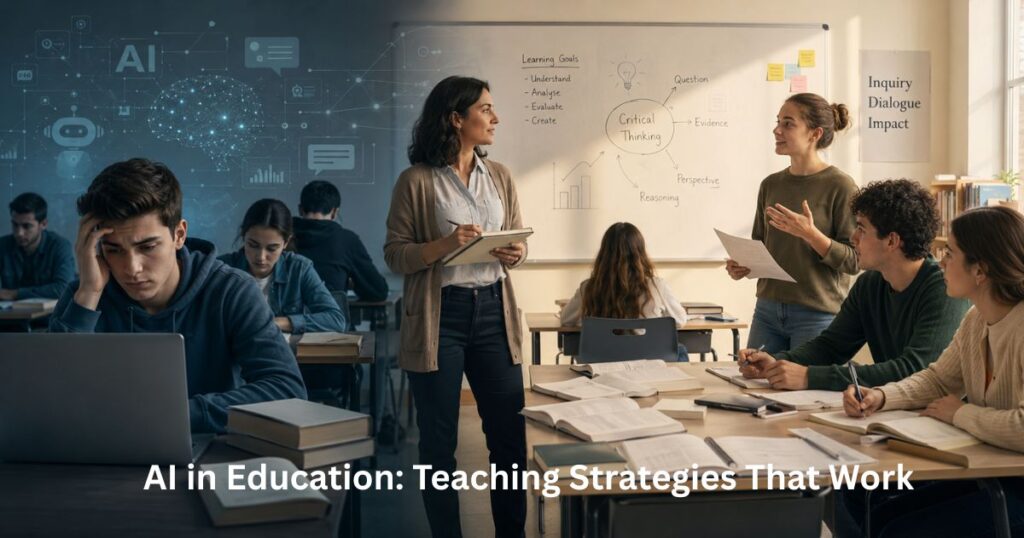
AI in education is changing fast. Learn practical teaching strategies, better assessment methods, and responsible AI use for real classroom learning.
Introduction
You’re sitting in your office, reading a student essay that could pass for the work of a PhD candidate. The prose is polished. The argument is sophisticated. The citations are flawless.
Then you ask the student to explain the argument in person, and they can’t. They stumble over their own thesis. They can’t tell you why they chose one source over another. The essay wasn’t theirs. An AI wrote it, and the student learned nothing from submitting it.
This is happening in classrooms everywhere, right now, at every level of education. It forces a question you can no longer postpone: what do you do about it and how to use Ai in education in a judicious way.
The Numbers Tell the Story
This is not a fringe problem affecting a handful of struggling students. It is the new normal.
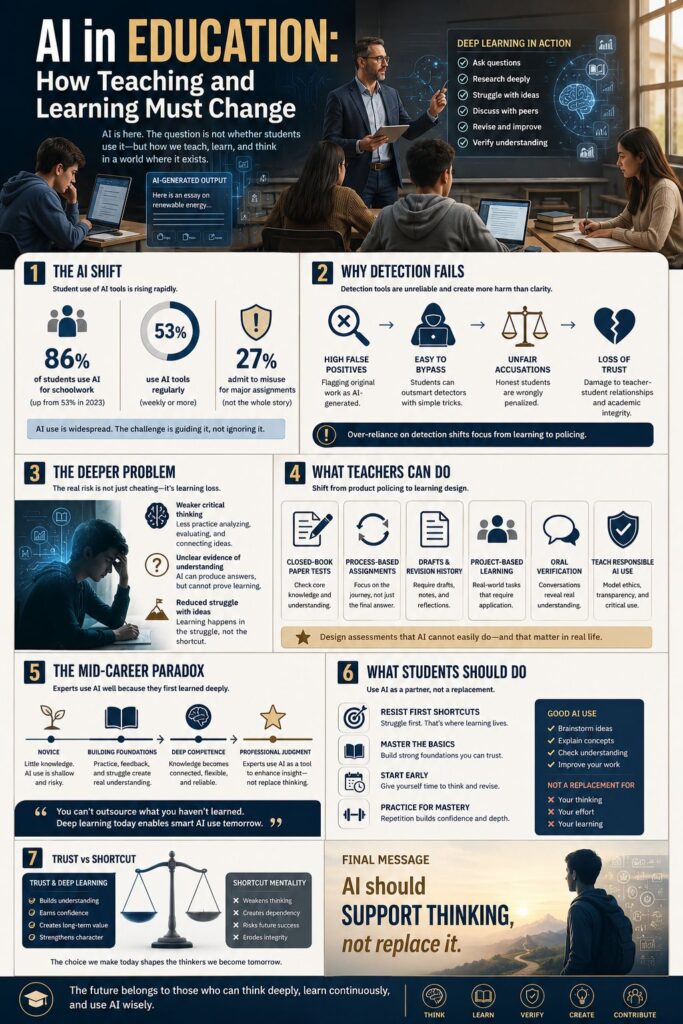
By December 2025, 62% of middle school, high school, and college students said they used AI for homework, up from 48% just seven months earlier, according to a RAND Corporation survey of the American Youth Panel. Zoom in on college specifically, and a Cornell University and UC Berkeley study of more than 95,000 students across 20 public research universities found that about one in three used generative AI regularly to help with coursework. Use varies sharply by field: 62% of computer science students reported regular use, compared with 24% of arts students.
Regular use is not the same as cheating, and the distinction matters. The same Cornell-Berkeley study estimated that 9% of students had used AI to cheat outright, a figure that climbed to 26% among students who used AI daily. Most students who use AI are not trying to defraud you. But a meaningful minority are, and daily use appears to be the strongest predictor of misuse.
Here is the part that should worry you more than the usage numbers: 67% of students now agree that using AI for schoolwork harms their critical thinking, up from 54% less than a year earlier. Students are using AI more, and they believe more strongly than ever that it is damaging them. That combination tells you something important. This is not a knowledge gap you can close with a lecture on academic integrity. Students already know the risk. They are taking it anyway, because deadlines, grades, and workload push them toward the shortcut regardless of what they believe about its cost.
The Enforcement Fantasy
Faced with these numbers, many institutions reached for the obvious tool: detection software. They bought licenses, wrote new misconduct policies, and told students they would be caught.
It hasn’t worked, and the evidence against detection keeps piling up.
Turnitin, the most widely used tool in this space, reports its own sentence-level false-positive rate at roughly 4%. That means that for every 100 sentences its tool flags as AI-written, about 4 are actually written by a human being. The company itself advises instructors not to treat a detection score as proof of misconduct. MIT has documented the same weakness from the other direction: AI-generated text can be lightly edited, or run through a paraphrasing tool, and the detection rate collapses. Independent testing has also found that detectors misfire more often on writing by non-native English speakers, whose more formulaic sentence patterns resemble the statistical fingerprints these tools are trained to catch.
Several New Zealand universities, including Massey, Auckland, and Victoria, have abandoned AI detection software entirely. Dr. Angela Feekery, president of Massey’s Tertiary Education Union branch, put it plainly: research shows the tools don’t work well, and students can bypass them easily, so switching them off was the only sensible option. In Australia, at least a dozen universities are still running detection software and still getting it wrong. One Sydney high school student was pulled out of class twice in five days and questioned about a 3,000-word assignment he had written himself. His teacher’s words to him were blunt: we know you didn’t do it, but you need to prove it. The Associated Press later found that almost two-thirds of AI-detection alerts issued in schools were false alarms, including more than 200 raised against ordinary student homework.
Put the pieces together and you get an unwinnable arms race. Detection tools chase a moving target, since each new model writes differently from the last one. Students can defeat almost any detector with a few minutes of editing. And every false accusation, however well-intentioned, costs you something you cannot easily rebuild: your students’ trust. Once a student has been wrongly accused, or has watched a classmate go through that experience, they stop believing the system is fair. A classroom without that basic trust is much harder to teach in.
The Real Problem: Students Aren’t Learning
Here is what should actually keep you up at night. It isn’t the cheating. It’s the learning that isn’t happening, even among students who never touch a chatbot.
A study of 4,354 high school students across six U.S. schools found that overall cheating rates have stayed close to their historical baseline, around 72%. That number is worth sitting with. AI has not created a new generation of cheaters. Cheating was already common before ChatGPT existed. What AI has changed is the mechanism: instead of copying a classmate’s answer or buying an essay online, students can now generate original-looking work in seconds, work that passes plagiarism checks because, technically, it isn’t plagiarized from anyone.
That shift has quietly broken your ability to read your own classroom. In one national survey, 53% of educators named “difficulty assessing student learning when AI is used” as a major concern, a figure that held at 47% in Wisconsin specifically. When a well-written essay could have been produced by the student, by an AI, or by some negotiation between the two, the essay stops functioning as evidence of anything.
The most troubling pattern shows up in the research on critical thinking itself. Large-scale studies tracking thousands of students find that the heaviest AI users score worst on critical thinking assessments. This is not a coincidence, and it is not simply a matter of struggling students turning to AI as a crutch. Researchers have found that most students intellectually recognize that heavy AI use might weaken their thinking, and use it heavily anyway. Knowing the risk does not stop the habit, because the habit is driven by short-term pressure, and the cost is long-term and invisible until it isn’t.
Why Banning AI Is the Wrong Move
Given all of this, banning AI outright looks tempting. It is also a mistake, for three reasons.
First, you cannot enforce a ban. The detection arms race is unwinnable, as the previous section showed, and pursuing it turns you into an investigator instead of a teacher. You will spend hours defending flagged papers to parents and administrators instead of teaching.
Second, your students will need AI in their careers, whether or not they touch it in your classroom. AI fluency is becoming a basic requirement across business, healthcare, marketing, education, research, and administrative work. A university that bans AI entirely is not protecting its students. It is sending them into a workplace that assumes a skill they were never allowed to practice.
Third, you are not only fighting AI. You are fighting the aftermath of remote learning. The pandemic left many students with what researchers have called a double disadvantage: years of eroded study habits from remote schooling, followed immediately by the arrival of a tool that offers the ultimate shortcut. A ban addresses none of that underlying erosion. It only removes one tool from students who have already learned, over several formative years, to look for the easiest way through an assignment.
What Actually Works
None of this means you are powerless. The strategies below are already running in real classrooms. They take more effort than a detection license, but they produce results a detector never will.
Return to fundamentals with closed-book paper tests. This remains your single most reliable tool. A student sitting in a room with only a pen and paper cannot outsource their knowledge to anyone. The University of Auckland’s computer science department has already moved this way; one of its graduate teaching assistants described in-person paper testing as simply the best solution they have found at the course level. The catch is workload. Grading handwritten exams for a large class takes far longer than running submissions through a plagiarism checker, so this approach only works if your institution backs it with real support: reduced teaching loads, grading assistance, or dedicated release time. Ask for it directly. Don’t absorb the cost quietly.
Redesign assignments around process, not just output. A modern AI model can produce a competent five-paragraph essay in seconds. What it cannot do is fake the messy, iterative process behind genuine intellectual work: the false starts, the discarded drafts, the moment a source contradicts your thesis and you have to rework your argument. Ask for that process explicitly. Require drafts at intermediate stages. Ask for annotated bibliographies that show a student’s reasoning about which sources matter and why. Request version histories from collaborative documents, which show you exactly when and how an idea developed.
Project-based learning fits especially well here, because it grounds assessment in active inquiry and real-world problem-solving rather than a single finished text. Instead of asking “what were the causes of World War I,” ask a student to script a podcast episode explaining the war’s origins to a general audience, design a museum exhibit around one contested cause, or draft a policy memo arguing for a specific diplomatic response. Each of these tasks demands the same historical knowledge as a traditional essay, but wraps it in a form, audience, and set of constraints that a generic AI prompt handles poorly, and that mirrors the kind of applied thinking your students will actually do after they graduate.
Maintain standards through verification. Your grades only mean something if employers can trust that a degree reflects real knowledge. Protect that meaning by verifying learning directly, through paper tests, oral exams, lab work, and studio-based assessment, wherever the stakes are highest. Dr. Ulrich Speidel at the University of Auckland estimates that in remote, unproctored exams, between 30% and 60% of students take some form of illicit help. That number should settle any lingering assumption that honesty alone will hold in an unmonitored setting. Verification is not a sign of distrust in your students generally. It is an acknowledgment that a system relying entirely on the honor of every individual will eventually be exploited by enough of them to undermine the credential for everyone else.
Teach responsible AI use. Since your students will use AI regardless of what happens in your classroom, teach them to use it well. Show them tasks where AI genuinely helps, such as summarizing background research or checking grammar, and tasks where it actively hurts them, such as generating an argument they haven’t thought through themselves. Have them fact-check AI output against primary sources. Give them a flawed AI-generated answer and ask them to identify exactly where the reasoning breaks down. That exercise does more for critical thinking than any lecture on the dangers of AI, because it forces the student to hold the standard of correct reasoning in their own head rather than borrowing it from a machine.
The goal across all four strategies is the same. You are not trying to eliminate AI from your students’ lives. You are trying to make sure that using it never substitutes for thinking.
The Mid-Career Paradox
Here is something that gets far too little attention in this conversation. Experienced professionals can use AI well precisely because they spent years doing the boring, entry-level version of their job first. A radiology resident who has personally read thousands of scans can look at an AI’s suggested diagnosis and immediately sense when something is off. A junior lawyer who has spent two years drafting contracts by hand develops an instinct for a clause that looks fine but doesn’t actually protect the client. That instinct is not something you can read about. It comes from doing the tedious foundational work often enough that your brain builds an internal model of what correct work looks like, so you recognize the wrong answer even when it is fluently written and confidently presented.
Now ask the harder question: if AI does all of that foundational, entry-level work for today’s students, where will their internal model come from? A first-year student who has an AI draft every early essay never personally struggles with organizing an argument, so they never build the instinct that lets a mid-career professional catch an AI’s mistake ten years from now. The paradox is that the very expertise that makes AI safe to use in a profession is exactly what AI threatens to prevent students from developing.
This is the deeper threat behind this whole conversation. It is not that students will cheat their way to a diploma. It is that an entire generation could skip the foundational practice that produces real expertise, and arrive at their careers unable to tell good AI output from bad because they never built the internal model that recognizes the difference.
What Teachers Need to Do
This is exhausting. You are being asked to redesign your entire teaching practice while still covering content, managing a classroom, and grading everything that lands on your desk. That is a genuine burden, and it deserves to be named honestly rather than waved away with encouragement.
Still, despair changes nothing. Action does, and two things help most.
Treat the redesign as a real design problem, not a punishment. The most creative teaching happening right now comes from educators who approached AI as a challenge to solve rather than a threat to survive. They tried an assignment format, watched it fail, adjusted it, and tried again until something worked for their specific students and subject. That iterative mindset produces better assignments than any single template ever will.
Ask directly for the resources this requires. You cannot redesign every assessment in your course on top of a full existing workload without support. You need time, and that means release from some other duty. You need institutional backing for the more labor-intensive assessment formats described above. Your administration needs to invest in real research on what teaching looks like in this new environment, rather than leaving each instructor to improvise alone. Don’t accept “figure it out yourself” as an answer. Ask for what the work actually requires.
What Students Need to Do
If you’re a student reading this, four things will serve you better than any AI shortcut ever will.
Resist the first temptation. Once you let a machine do your thinking for you a single time, doing it yourself the next time gets harder, not easier. You lose the habit of sitting with a hard problem before reaching for help. The first assignment is the hardest one to do honestly. After that, it gets easier to cut corners again, and that ease is exactly the problem.
Master the basics before you reach for shortcuts. You cannot handle a harder assignment if you skipped the foundational material from the first few weeks of a course. AI can help you fake your way through that harder assignment, but faking it doesn’t give you the understanding underneath it, and that gap eventually surfaces, usually at the worst possible moment: an in-person exam, an oral defense, or a job that assumes you already know what your degree says you know.
Start early. Deadline pressure is the single biggest reason students turn to AI in a panic. Starting a few days earlier gives you room to think slowly, get stuck, and work through being stuck, which is where most of the actual learning happens. Most of the pressure that pushes students toward AI is self-inflicted, and most of it is fixable with better timing.
Practice for mastery. Every mid-career expert you admire got there by doing the hard, unglamorous groundwork first: the reps, the failed attempts, the slow correction of bad habits. Using AI to skip that groundwork doesn’t accelerate your path to their level. It removes the path entirely, because the groundwork is where the skill comes from, not an obstacle standing between you and it.
A Final Word
This was never really about the technology. It’s about what learning is for.
AI is here, it will keep getting more capable, and your students will use it whether or not you approve. The real question isn’t whether AI belongs in education. It already does. The real question is whether a degree, a diploma, or a passing grade will still mean that the person holding it actually knows something.
You can redesign your assessments, hold your standards, and still make room for these new tools. It takes real effort, real creativity, and real institutional support. But it is possible, and it matters, because a student who cannot think without AI has not been educated at all. They have only been credentialed.
Further Reading and Related Texts
- Chirikov, I., Smirnov, I., & Kizilcec, R. F. (2026). “Generative AI Use and Misuse Call for Assessment Reform in Higher Education.” Science. The primary study behind this article’s core statistics; useful for readers who want the full methodology behind the one-third usage and 9% misuse figures.
- Schwartz, H. L., & Diliberti, M. K. (2026). More Students Use AI for Homework, and More Believe It Harms Critical Thinking. RAND Corporation. The American Youth Panel report tracking the rise in student AI use alongside students’ own growing unease about it.
- Selwyn, N. (2019). Should Robots Replace Teachers? AI and the Future of Education. Polity Press. A sober, non-alarmist look at what automation can and cannot do in a classroom, written before the current generative AI wave but still the clearest framework for thinking about where technology belongs in teaching.
- Watters, A. (2021). Teaching Machines: The History of Personalized Learning. MIT Press. A history of a century of promises that machines would fix education. Essential context for anyone tempted to treat the current moment as unprecedented.
- Mollick, E. (2024). Co-Intelligence: Living and Working with AI. Portfolio. A practical, non-technical guide to working alongside AI tools without losing your own judgment, directly relevant to the mid-career paradox discussed above.
- Bowen, J. A., & Watson, C. E. (2024). Teaching with AI: A Practical Guide to a New Era of Human Learning. Johns Hopkins University Press. A classroom-level companion to this article, with concrete assignment redesigns for instructors ready to move past detection software.
Sources
- College Board. (2025). New Research: Majority of High School Students Use Generative AI for Schoolwork. newsroom.collegeboard.org
- Chirikov, I., Smirnov, I., & Kizilcec, R. F. (2026). “Generative AI Use and Misuse Call for Assessment Reform in Higher Education.” Science; reported via Cornell Chronicle and EurekAlert.
- De Jager, B. (2026). “Teachers are worried about students cheating with AI, but my survey suggests the deeper issue is learning.” The Conversation.
- Educational Technology Research and Development. (2026). “Cheating in the second year of generative AI chatbots: a follow-up study on high school student cheating behaviors.” Springer.
- RNZ. (2025). “Universities give up using software to detect AI in students’ work.” rnz.co.nz
- ABC News. (2025). “Over a dozen universities are using AI to catch AI — and getting it wrong.” abc.net.au
- ABC News. (2025). “High school students forced to fight false allegations of AI cheating.” abc.net.au
- Indian Weekender. (2025). “Universities Drop AI Detection Tools, Cite Ineffectiveness.”
- RAND Corporation. (2026). Schwartz, H. L., & Diliberti, M. K. More Students Use AI for Homework, and More Believe It Harms Critical Thinking.
- MIT. (2025). “AI Detection Software Doesn’t Work.”
- University of Waterloo. (2025). “Discontinuing use of AI detection functionality in Turnitin.”
- Turnitin. “Understanding AI Writing Detection: False Positive Rates.” turnitin.com/blog

Author: mkalam
Educator and content creator