


Introduction
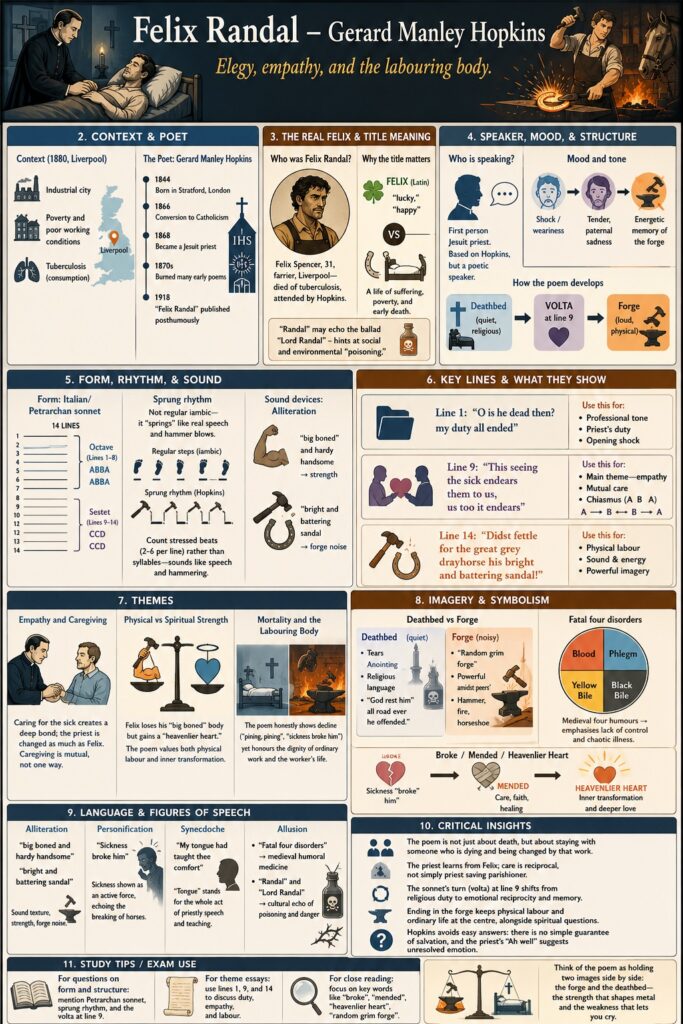
Gerard Manley Hopkins wrote “Felix Randal” in 1880 while serving as a curate in Liverpool, a poor industrial city. The poem is an elegy for a thirty-one-year-old farrier (a blacksmith who shoes horses) named Felix Spencer. You watch Hopkins, the poem’s speaker, move from the shock of hearing about the man’s death to a loving memory of his strength as a craftsman.
The Poet: Gerard Manley Hopkins
Gerard Manley Hopkins (1844–1889) was an English poet and a Jesuit priest. He converted to Catholicism in 1866. After his conversion, he burned his early poems, believing they were too worldly. He wrote “Felix Randal” privately, and the poem was only published after his death in the 1918 edition of his collected works.
Why the Title Matters
The title uses the farrier’s full name, “Felix Randal.” The name creates a specific irony you should notice. “Felix” means “lucky” or “happy” in Latin. Felix Randal suffers a painful death from tuberculosis. The contrast between his name’s meaning and his reality makes his death feel more unfair.
The Real Story Behind the Poem
This poem comes from a specific real event. Hopkins recorded the death of a man named Felix Spencer in the church records of St. Francis Xavier’s in Liverpool . Spencer died from tuberculosis at age 31. As his priest, Hopkins would have visited him, given him the last rites (anointing with oil), and officiated at his funeral . The forge in the poem was a real place in Liverpool’s industrial landscape.
Who is Speaking?
The poem uses a first-person speaker, a Jesuit priest. This priest is Hopkins himself. The speaker starts by reacting to a specific event: hearing about Felix’s death. The line “my duty all ended” shows you that the priest’s professional responsibility to care for Felix’s soul is finished.
Mood and Tone
The poem’s mood shifts. It starts with shock and weariness in line one (“O is he dead then?”). It moves to a tender, paternal sadness when the speaker calls the dying farrier “child, Felix, poor Felix Randal.” The final three lines are energetic and loud as the speaker remembers the noise of the forge, the “battering sandal.”
The Main Ideas
The poem explores how caring for someone dying changes you. Line 9 contains the central argument: “This seeing the sick endears them to us, us too it endears.” You cannot watch someone suffer without feeling closer to them. The poem also argues that physical strength is temporary. Felix’s “big-boned” body fails him, but his soul receives “reprieve and ransom” through forgiveness.
Line-by-Line Breakdown
Lines 1-4:
“Felix Randal the farrier, O is he dead then? my duty all ended,
Who have watched his mould of man, big-boned and hardy-handsome
Pining, pining, till time when reason rambled in it, and some
Fatal four disorders, fleshed there, all contended?”
The priest reacts to the news of death. He recalls watching Felix’s body (his “mould of man”) waste away. The “fatal four disorders” refers to the old medical theory of the four humors (blood, phlegm, black bile, yellow bile). The speaker imagines these four diseases fighting over Felix’s body.
Lines 5-8:
“Sickness broke him. Impatient, he cursed at first, but mended
Being anointed and all; though a heavenlier heart began some
Months earlier, since I had our sweet reprieve and ransom
Tendered to him. Ah well, God rest him all road ever he offended!”
Sickness destroys Felix. At first, he curses his situation. But he “mended” his attitude after the priest anointed him. The “sweet reprieve and ransom” means Holy Communion or absolution (forgiveness of sins). The priest then prays for God to forgive any sins Felix committed.
Lines 9-11:
“This seeing the sick endears them to us, us too it endears.
My tongue had taught thee comfort, touch had quenched thy tears,
Thy tears that touched my heart, child, Felix, poor Felix Randal;”
The poet states the main theme: watching the sick makes you love them. He says his words (“tongue”) and his touch (anointing or holding a hand) offered comfort. But Felix’s tears also made the priest feel love. The priest calls him “child,” showing how the strong man became vulnerable and dependent.
Lines 12-14:
“How far from then forethought of, all thy more boisterous years,
When thou at the random grim forge, powerful amidst peers,
Didst fettle for the great grey drayhorse his bright and battering sandal!”
The speaker contrasts the deathbed with Felix’s healthy past. He remembers the “random grim forge” (a noisy, chaotic, dark workshop). Felix was “powerful” compared to other workers. He “fettled” (made or repaired) a metal shoe for a heavy “drayhorse” (a workhorse). The sound of the poem changes here, using the hard “b” sound in “bright and battering” to mimic the noise of a hammer.
How the Poem Develops
The poem moves from the deathbed to the workshop. The first part is quiet, sad, and religious. The last part is loud, strong, and physical. This change happens at line 9, the “volta” or turn of the sonnet.
Form and Versification
–Form: Italian or Petrarchan sonnet. It has 14 lines. The rhyme scheme is ABBA ABBA in the first eight lines (octave) and CCD CCD in the last six lines (sestet) .
– Meter: Hopkins used “sprung rhythm.” You do not count the syllables. You count the stressed beats per line. A line can have 2 to 6 stressed syllables. This rhythm mimics natural speech and the irregular pounding of a blacksmith’s hammer.
Language and Figures of Speech
Alliteration: Hopkins repeats consonant sounds to create texture.
– Example: “big-boned and hardy-handsome” (line 2) uses the repeated ‘h’ and ‘b’ sounds to emphasize Felix’s physical bulk.
Personification: The poem gives human actions to abstract things.
– Example: “Sickness broke him” (line 5). Sickness acts like a person who destroys an object.
Synecdoche: The poem uses a part of something to stand for the whole.
– Example: “My tongue had taught thee comfort” (line 10). The tongue stands for the priest’s entire act of speaking and teaching.
Allusion: The poem references older ideas without explaining them.
– Example: “Fatal four disorders” (line 4) alludes to the medieval theory of the four bodily humors .
Key Quotations
“O is he dead then? my duty all ended” (Line 1)
– Use this for: Hopkins’s unique tone or the priest’s professional role.
“This seeing the sick endears them to us, us too it endears” (Line 9)
– Use this for: The poem’s main theme of empathy and mutual care.
“Didst fettle for the great grey drayhorse his bright and battering sandal!” (Line 14)
– Use this for: Imagery, sound, or how the poem celebrates physical work.
Themes
– Empathy and Caregiving: The poem argues that the act of caring for the sick creates a bond stronger than a simple priest-parishioner relationship.
– Physical vs. Spiritual Strength: You see Felix lose his “big-boned” body but gain a “heavenlier heart.”
– Mortality: The poem does not hide death. It shows you the physical process of “pining” and the confusion of “reason rambled.”
Connections to Modern Poetry
Unlike Victorian poets such as Alfred Lord Tennyson, who wrote smooth, musical elegies for famous people, Hopkins wrote a rough, quiet poem for an unknown worker. Hopkins influenced modern poets who wrote about ordinary life. You can see his focus on manual labor in the poems of Seamus Heaney, such as “The Forge.”
Critical Analysis
The Priest Who Learns from the Dying
An elegy written by a priest might be expected to dwell primarily on the afterlife and the state of the soul, yet “Felix Randal” focuses instead on a relationship between two living people: one dying, one caring, and both changing in the process. The priest-speaker does more than administer sacraments; through tending Felix, he discovers a new emotional vulnerability. In this sense, the farrier does not simply receive spiritual care; he also educates the priest in compassion and feeling. For essays on theme, this section is useful when arguing that caregiving in the poem is mutually transformative rather than one‑sided.
The Unlikely Bond
The poem opens with a line that seems almost professionally detached: “Felix Randal the farrier, O is he dead then? my duty all ended.” The phrasing suggests a task completed, as if the priest’s case has been formally closed. That apparent coolness is quickly exposed as a defensive surface, however, once the speaker recalls watching Felix “Pining, pining,” a repetition that implies prolonged, painful observation rather than casual notice. Biographical evidence underlines this intimacy: Hopkins attended a real farrier, Felix Spencer, a thirty‑one‑year‑old blacksmith in Liverpool who died of tuberculosis after receiving last rites. The altered surname “Randal” may also echo the ballad “Lord Randal,” where a young man is poisoned, inviting readers to consider how social and environmental conditions “poison” Felix Randal rather than a single identifiable agent. This discussion can support exam questions on dramatic structure and on the complex tone of the opening octave.
What the Body Teaches
The poem continually confronts the reader with the dismantling of a once powerful body. Felix was “big‑boned and hardy‑handsome,” described as a “mould of man,” a phrase that hints at an ideal bodily form. The word “mould” is especially resonant: a mould shapes metal, just as Felix himself shapes metal in his work at the forge. Illness reverses this relation of control, reshaping the farrier so that the same body that once hammered shoes for “the great grey drayhorse” becomes a site where “fatal four disorders” contend. The phrase “fatal four disorders” alludes to medieval humoral theory—blood, phlegm, yellow bile, and black bile—according to which health depends on balanced bodily fluids. Hopkins’s use of this outdated medical vocabulary emphasizes both the vulnerability of the body and the limited power of contemporary medicine; Felix does not succumb to a single illness but to a chaotic imbalance figured as four forces fighting over him. This section is particularly useful for questions on imagery, irony, and the poem’s representation of the body.
The Volta That Changes Everything
Line 9 marks the poem’s volta, the structural and emotional turn of the sonnet: “This seeing the sick endears them to us, us too it endears.” This line crystallizes a central idea: sustained “seeing” here means witnessing and remaining present in another’s suffering, not simply looking from afar. The priest is not portrayed as a purely ritual functionary; he is someone who watches and stays. Formally, the sentence folds back on itself—“endears them to us, us too it endears”—creating a chiasmus (A‑B‑B‑A) that enacts the reciprocity it describes. The priest’s comfort is not unidirectional: Felix’s tears “touched my heart,” and the tender vocative “child, Felix, poor Felix Randal” reveals a paternal, even vulnerable, affection. At the same time, the phrase also carries the grief of someone acutely aware that his care cannot ultimately prevent death. This analysis can be deployed when discussing the poem’s dramatic progression or arguing that line 9 functions as a thematic thesis statement.
The Violence of Caring
Hopkins repeatedly draws on rough, physical diction to register the impact of illness and care alike. “Sickness broke him” is a blunt, almost brutal formulation, belonging to the vocabulary of taming or “breaking” horses rather than consolatory religious language. The echo of equestrian terminology is pointed, given that a farrier works with horses: the same lexicon that describes Felix’s strength and skill now describes what sickness does to him. At the same time, “broke” suggests training or yielding; a broken horse learns to accept the rider. Initially Felix “cursed” his condition, resisting his fate, but through the priest’s care he “mended”—not physically, but spiritually—accepting his death with what the poem presents as a new inner strength. The “heavenlier heart” that “began some / Months earlier” suggests that grace was already at work before the formal anointing, complicating any simple chronology of sacramental efficacy. These observations are helpful for essays on the poem’s religious dimension and on its treatment of spiritual versus physical change.
Why the Forge Matters
Strikingly, the sonnet ends not at the bedside but in the forge, offering three lines of concentrated physical energy:
“When thou at the random grim forge, powerful amidst peers,
Didst fettle for the great grey drayhorse his bright and battering sandal!”
The verb “fettle,” a dialect term meaning “to make or repair,” is sharp and specific, sounding like the brisk skill it denotes. The phrase “battering sandal” refers to the horseshoe, and “battering” conveys both the repeated hammer‑blows and the force of the labor itself. Hopkins, who worked in Liverpool’s poor districts, evokes the forge as grimy, chaotic, and dangerous—“random grim”—without sentimentalising it as purely noble suffering. Yet this is the space in which Felix is “powerful amidst peers,” a phrase that insists on his competence and status within his working environment. The poem refuses to declare whether this remembered physical vigor or the attained spiritual composure is “more important”; instead, it holds both images in unresolved tension.
How Form Creates Meaning
Formally, “Felix Randal” is a Petrarchan sonnet, with an octave and sestet following the rhyme scheme ABBA ABBA CCD CCD. However, Hopkins’s use of sprung rhythm means that the poem counts stresses rather than maintaining a fixed syllable count per line, resulting in lines with varying numbers of unstressed syllables but two to six stressed beats. This pattern produces a rhythm that often resembles heightened speech and, at key moments, the irregular pounding of a blacksmith’s hammer. Reading the final three lines aloud highlights strong stresses on phrases such as “random grim forge,” “powerful amidst peers,” and “bright and battering sandal”; combined with dense alliteration in the plosive “b” and “g” sounds, this creates a muscular, effortful music.
What the Poem Does Not Say
It is equally important to notice what the poem leaves unstated. The sonnet never explicitly guarantees Felix Randal’s salvation in conventional doctrinal terms. The priest’s prayer—“God rest him all road ever he offended”—is a request, not an assertion; “all road,” meaning “in any way” in local dialect, acknowledges the possibility of multiple faults while entrusting judgment entirely to God. This restraint signals a pastoral humility: the speaker does not claim knowledge of Felix’s ultimate fate. Likewise, the poem does not depict the priest as finding final, untroubled peace. The phrase “Ah well” in line 8 sounds like a small exhalation of resignation rather than triumphant closure, suggesting that his experience of care has left him unsettled as well as moved. These omissions can form the basis of an argument that Hopkins resists neat
Conclusion
You can read “Felix Randal” as a poem about death. But you will understand it better as a poem about the work of watching someone die. Hopkins does not give you easy answers. The priest does not walk away healed. He walks away with his heart touched, which means he walks away changed. The forge and the deathbed sit side by side in this sonnet. Hopkins refuses to say which one matters more. You need both: the strength that shapes metal and the weakness that lets you cry. When you close the poem, you remember the “battering sandal” and the “child, Felix.” You remember a man who cursed at first but mended. That is Hopkins’s real subject. Not the soul leaving the body. The person staying in the room.
Sources:
– Cambridge University Press. (2025). Masculinity and the Labouring Body .
– Cambridge University Press. (2025). Northern England .
– GradeSaver. “Felix Randal Literary Elements” .
– LitMed, NYU. “Felix Randal” .
– Numerade. Analysis of “Felix Randal” .
– Wikisource. Poems of Gerard Manley Hopkins, 1918 .

Author: mkalam
Educator and content creator