

A clear guide to the meaning of literature, its purposes, and why studying literary texts matters in education and everyday life
Introduction
What is literature? In the simplest sense, literature is a creative art that uses language to shape human experience into poems, plays, novels, and other meaningful forms. It does not merely report facts. It selects, arranges, and transforms life into a form that invites thought, feeling, and interpretation.
This question matters because literature is not separate from ordinary life. It helps you see how people think, feel, suffer, imagine, and judge one another. When you ask what literature is, you are also asking how language turns experience into meaning and why that process has remained central to human culture for centuries.
- Introduction
- Literature as Creative Art
- The Main Purposes of Literature
- Experience as the Source of Literature
- Selection and Judgment in Literature
- Literature and Human Values
- Literature as a Source of Knowledge
- Literature Is More Than a Report
- How to Read Literature Well
- The Functions of Literature
- Literature and the Reader’s Mind
- Why Literature Matters to Readers
- Literature and Real-Life Experience
- Defining Literature
- Why Literature Is Hard to Define
Literature is both an art and a way of knowing. A novel, a poem, or a play may present ideas about society, morality, love, power, or death, but it does so through form, image, rhythm, character, and story. That is what gives literature its force. It does not explain life in the dry language of report; it recreates life in a way that you can enter, question, and remember.
At the same time, literature carries ideas across generations. It preserves the values, fears, and ideals of the culture that produced it, while also speaking to readers far removed from that culture. A work of literature can remain alive for centuries because it offers more than information. It offers insight shaped by artistic language.
To study literature, then, is not simply to collect plots, characters, and themes. It is to understand how writers use imagination, selection, and style to reveal human truth. That is why literature continues to matter in education, criticism, and everyday reading.
Types of Literature: Poetry, Prose, and Drama
In practice, literature usually falls into three broad types: poetry, prose, and drama. Poetry compresses experience into patterned language, prose unfolds it in narrative or essay form, and drama presents it through dialogue and performance. Each type uses different techniques to achieve the same aim: a selective, heightened imitation of life that invites you to reflect rather than receive information.
Literature as Creative Art
Start with the most basic claim: literature is a work of art, made deliberately by an artist. That distinguishes it immediately from ideas, theories, or systems of thought. A novel or a poem may contain philosophy, but philosophy does not define it, any more than the physics of pigment defines a painting.
An artist transforms experience rather than recording it. A journalist reports what happened. A historian arranges events into a coherent account. A literary artist takes the same raw material – the same facts, the same events – and remakes it into something that carries meaning, feeling, and truth that the bare record cannot hold.
Homer’s Iliad shows this transformation clearly. The Trojan War may well have been a real conflict fought over trade routes and dynastic pride. Homer had no interest in cataloguing troop movements or peace negotiations. He built an epic about rage, honor, mortality, and the cost that pride exacts from everyone it touches. History supplied the material. Homer supplied the art.
In classroom terms, you could say that Homer turns a historical war into a story about anger, honor, and mortality that still speaks to you even if you know nothing about Bronze Age politics.
The Main Purposes of Literature
Literature does two things at once, and it does them together rather than in sequence.
First, it expresses truth through beauty. A novel or poem does not simply state a fact; it presents that fact in a form built for contemplation rather than quick consumption. You slow down when you read a well-made sentence. That slowing down is not incidental – it is the point. Beauty asks you to stay with an idea long enough to feel its weight, not just register its content.
Second, literature communicates ideas that matter, intellectually and socially. It carries the author’s view of the world forward to readers who were not there to witness the events that produced it. It also feeds writers later, who take up the same questions and answer them differently. This is how a literary tradition becomes a continuous conversation across centuries rather than a pile of unrelated books.
Dante’s Divine Comedy does both at once. It sets out a theology of sin, judgment, and divine love, and it does so in terza rima, an interlocking rhyme scheme that pulls the reader forward line by line. Seven hundred years after Dante wrote it, readers still meet that theology through that same formal beauty. The form has not become a costume around the ideas; it is how the ideas reach you.
Core Thesis
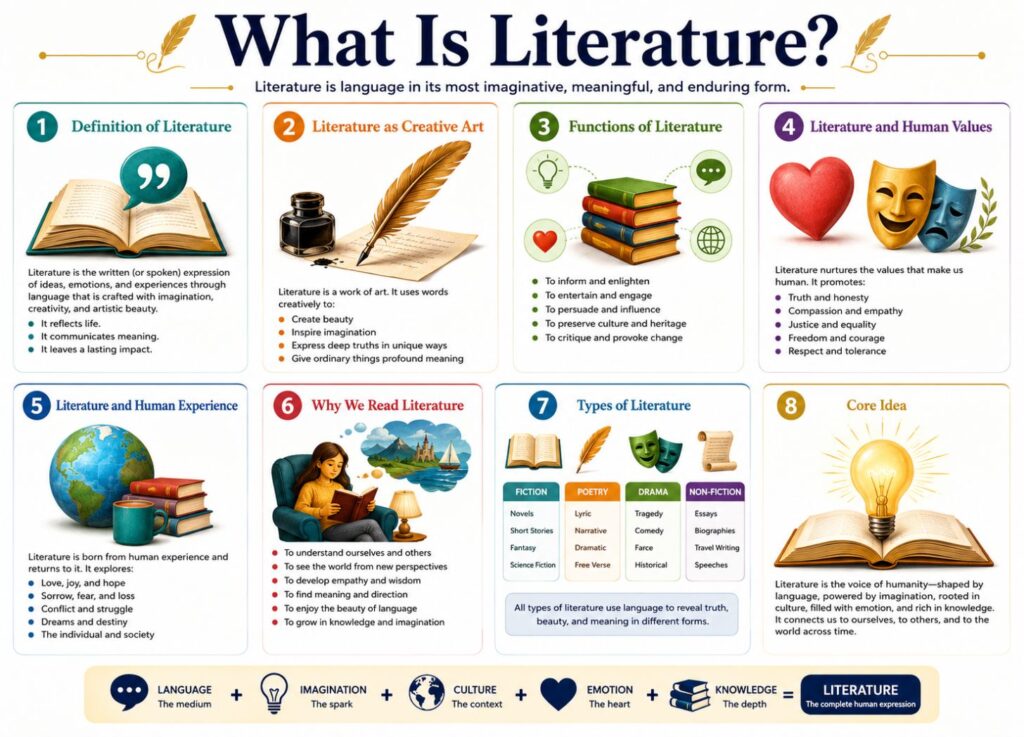
Literature is a creative art that reshapes human experience into a selective, heightened imitation of life. Through beautiful language and serious ideas, it acts as a criticism of life, preserving cultural values, deepening readers’ understanding, and extending your experience far beyond what one lifetime can gather.
Experience as the Source of Literature
Every literary work begins in experience, lived or imagined. This is where Aristotle’s theory of mimesis becomes useful. Writing in the fourth century BCE, Aristotle defined art as imitation of life – but he did not mean copying. He meant something more demanding: a heightened, selective imitation that leaves out what does not matter and sharpens what does.
In the Poetics, Aristotle draws a distinction that still holds up. The poet’s task is not to record what happened, but to show what could happen – what is possible according to probability or necessity. A historian is bound to particular facts: this battle, on this date, involving these named commanders. A poet is free to pursue the general truth those facts might illustrate. This is why Aristotle ranked poetry above history in seriousness: history tells you what one person did; poetry tells you what any person, under those pressures, might do.
Hamlet makes the point concrete. Shakespeare was not writing a biography of an actual Danish prince. He built a character whose problems – how to act on suspicion without proof, how doubt corrodes resolve, what a person owes the dead – belong to no single century. Hamlet’s soliloquy on being and not being still lands because it never depended on the political situation in medieval Denmark. It depended on a mind turning against itself, which is a condition available to anyone.
Selection and Judgment in Literature
An artist does not gather experience indiscriminately. Selection is the job. The artist keeps what serves the work, discards what does not, and organizes the surviving material into a shape that carries meaning on its own.
That selection is never neutral. It reflects the artist’s values, standards, and judgment, which is why literature ends up functioning as a form of criticism, whether or not the author intends it that way. By choosing what to include, a writer is also saying what matters and what does not — and that act of choosing is itself an evaluation of life.
Matthew Arnold made this claim outright in his 1880 essay “The Study of Poetry”: poetry, he argued, is a criticism of life, and the poet is a critic of a higher order — one working with imagination and a trained sense of what is beautiful and what is noble.
Tolstoy’s War and Peace demonstrates the principle at scale. Tolstoy was not compiling a record of the Napoleonic campaigns. He picked particular scenes, particular characters, particular encounters, and through that selection built an argument against the idea that history is driven by great men making decisive choices. The novel is famously long partly because Tolstoy wanted to show history as the sum of countless small, undramatic actions rather than a few heroic ones – and every one of those small scenes had to be chosen with that argument in mind. Nothing in the novel is there by accident.
Literature and Human Values
Literature renders values, social ideals, and moral principles in concrete form rather than abstract statement. It shows you what a society believed, prized, and feared, at a level that a summary of that society’s laws or customs cannot reach on its own.
To understand any culture, you need some grip on how it saw human nature – what it assumed people wanted, feared, and owed each other. Literature gives you access to that assumption from the inside, because it dramatizes it rather than describing it.
Jane Austen‘s Pride and Prejudice is a useful case. On the surface, you are watching the marriage market of Regency England: class boundaries, financial pressure, the narrow range of choices available to women of a certain rank. But underneath that specific setting sits a more general conflict — between pride and self-knowledge, between what society expects and what personal integrity demands. Austen never states this conflict directly. She lets you watch Elizabeth Bennet misjudge Darcy, correct herself, and grow, and the argument emerges from that experience rather than from a stated moral.
Literature as a Source of Knowledge
Literature pulls in material from philosophy, history, science, and social thought, and it makes that material concrete by attaching it to a particular life.
An argument about justice, made in the abstract, stays an argument. Read Dostoevsky‘s Crime and Punishment, and you experience justice – and its collapse – through Raskolnikov’s reasoning before the murder, his unraveling afterward, and his eventual confession. Dostoevsky does not explain the psychology of guilt to you. He puts you inside it.
A history of the French Revolution gives you dates, casualty counts, and the sequence of governments that rose and fell. Victor Hugo’s Les Misérables gives you the texture underneath those facts: what it felt like to starve, to believe in a cause, to suffer for it, and occasionally to be redeemed by it.
Genetics can tell you how traits pass from one generation to the next. Faulkner‘s Absalom, Absalom! tells you what it feels like to be shaped and trapped by a family history you did not choose and cannot outrun.
Literature Is More Than a Report
Literature is not journalism, and it is not a chronological record of events. Confusing the two misses what literature is for.
What literature offers instead is experience that has already passed through an observing mind – evaluated, arranged, and given a shape that raw fact does not have on its own. Where a report aims for neutrality, literature aims for meaning, and meaning requires a point of view.
Different art forms work through different materials. Music works through sound and silence. Painting works through color and line. Literature works through language – and within language, through narrative, description, rhythm, and the musical qualities of well-built sentences. Because language can imitate the effects of the other arts, literature has a reach that few other art forms share.
How to Read Literature Well
Studying literature well means interpreting it, not memorizing it. You can know the plot of a novel in perfect detail and still have missed the book.
The philosopher and educator Mortimer Adler put this sharply: reading a great book purely for information, he suggested, wastes the book almost entirely — the value lies in what the reading demands of your understanding, not in the facts it hands you.
Take Moby-Dick. You can read it and come away knowing a great deal about nineteenth-century whaling – how a harpoon is thrown, how a sperm whale is rendered for oil, how a crew is organized on a whaling ship. That knowledge is real, but it is not the novel. Melville is using the voyage to ask questions about obsession, about the limits of human control, about what happens when a man decides that one whale is the entire meaning of his life. If you finish the book knowing only about whaling, you have read the packaging and missed the argument.
The Functions of Literature
Literature works by heightened imitation, carried out through artistic language, and its purpose is to make raw experience mean something. The strength of any given work depends on how well the writer selects, emphasizes, and organizes the material.
When selection is weak or absent, the result drifts toward plain transcription — a record with little shape and less emphasis, where every detail carries roughly the same weight because none of it has been chosen with care. Artistic value drops in direct proportion to how little judgment has gone into the arrangement.
The quality of a literary work, then, tracks four things: how deeply the writer has thought about the material, how skillfully the writer reshapes it, how well the writer selects from it, and how forcefully the writer expresses the result. Weakness in any one of these shows up in the finished work.
Literature and the Reader’s Mind
Literature compresses human emotion, action, conflict, and relationship into a form you can hold in your mind at once. That compression is part of what makes it useful to you as a reader: it lets you take in, in a few hours, patterns of feeling and behavior that would take years to observe directly in your own life.
Through that compressed experience, literature helps you interpret your own life. It gives you a way to organize your reactions to events, reflect on emotions you might otherwise only feel and never examine, and build insight you can carry back into your own circumstances.
Sophocles’ Oedipus Rex is a clear example. You are not simply absorbing a myth about an ancient king. You are watching a man’s greatest strength – his relentless pursuit of the truth – become the exact quality that destroys him. You watch knowledge arrive at the worst possible moment, not as liberation but as catastrophe. That reversal, once you have seen it dramatized, changes how you think about the risks of certainty in your own decisions.
Why Literature Matters to Readers
You read literature, in part, to appreciate art itself — the craftsmanship, the form, the style that a skilled writer brings to language.
You also read it to gain a kind of experience you could not otherwise have: imaginative, emotional, and intellectual experience gathered secondhand. Scholars call this vicarious experience – vicarious meaning, literally, “in place of.” Literature lets you live, briefly and safely, a life that is not your own: a soldier’s war, a stranger’s grief, a culture you will never visit.
Cognitive research on reading backs this up with more than intuition. When you read a literary narrative, your mind builds something like a working model of a human world – the setting, the sequence of events, the people moving through it. But you do not stop at tracking events. You also track the inner states of the characters: what they want, what they intend, what they feel and why. That tracking is what makes the reading experience feel psychologically real rather than merely informative.
As you read, you also pull your own memories forward to help make sense of what is happening on the page, and in doing so you update and reorganize those memories. Reading fiction, in other words, does not just add new content to your mind — it reshapes how you understand what was already there. That reshaping is one route by which sustained reading produces real personal growth, not as a byproduct but as a direct mechanical effect of how narrative comprehension works.
Literature and Real-Life Experience
Literary experience resembles direct experience, but it is not a substitute for it – it is a supplement. It adds intellectual range, sharpens critical thinking, deepens emotional maturity, and widens perspective in ways that direct experience alone, given the limits of any one life, cannot manage on its own.
A person who reads widely and well can develop mature judgment and a broad understanding of human situations even without having lived through most of them personally. This is not a small claim. It means that reading seriously is one of the few ways to gain the judgment of experience without paying the full cost of that experience.
Cervantes’ Don Quixote explores this relationship directly, and from an unusual angle. Don Quixote reads so many chivalric romances that he loses the ability to tell fiction from reality and sets out to live as a knight-errant in a world that no longer has any use for one. Read carelessly, the novel looks like a warning against reading too much. Read closely, it is something more interesting: an inquiry into how stories shape perception, for better and for worse, and into what happens when the line between the story and the life blurs completely.
Defining Literature
Defining literature turns out to be harder than it looks. The word comes from the Latin littera, meaning a letter of the alphabet – which gives you, at most, the definition that literature is a body of written work. That definition is far too wide to be useful.
Not everything written qualifies. Technical manuals, scholarly papers, and news reporting have traditionally been excluded from the category, even though all three involve skilled writing. Critics have instead applied the term mainly to imaginative work in poetry and prose, distinguished both by the author’s intention and by the aesthetic quality of the execution.
Merriam-Webster’s Collegiate Dictionary offers a working version: writing marked by excellence of form or expression, dealing with ideas of permanent or universal interest. That definition is workable but circular – it already assumes you can recognize excellence and permanence when you see them, which is exactly what a definition is supposed to help you do.
Terry Eagleton, in Literary Theory: An Introduction, takes the harder position that every proposed definition eventually fails. Define literature as imaginative or fictional writing, and the definition immediately excludes essays, sermons, philosophy, and letters — forms that have sat inside the literary canon for centuries despite being neither imaginative nor fictional in any strict sense.
The term also carries a broad and a narrow sense, and the two should not be confused. Broadly, literature means the entire body of written work a culture produces. Narrowly, it means the subset of that work distinguished by artistic merit, aesthetic value, and lasting significance. Classical Chinese usage shows the split with particular clarity. Terms like wen (文), wenzhang (文章), and wenxue (文学) originally covered all writing without distinction – scholarship, philosophy, history, and creative work together. The modern, narrower sense of literature as a distinct art form developed later, specifically around the question of how something is written, not only what it says.
Why Literature Is Hard to Define
Some theorists go further and argue that literature has no fixed essence at all. Eagleton makes exactly this claim, and he makes it on two grounds at once: literature has no stable ontological core, and it has no single function that all literary works share.
This is not a claim that literature does not exist. It is a claim that literature cannot be pinned to one unchanging definition. What counts as literature is a historical judgment, not a timeless fact. It shifts across centuries and across cultures, and a work excluded from the category in one period can be admitted to it in another – sermons and letters are again a useful case, since both have moved in and out of the literary canon depending on who was doing the judging.
The comparative scholar Qian Zhongshu proposed a different way through the problem. Rather than searching for a definition that covers every case, he argued for what might be called difference as essence: understanding literature through its specific, observable features rather than through an abstract formula meant to apply universally. Qian identified three elements running through literary work – emotion, artistry, and talent – and treated their combination, rather than any single trait, as what marks a text as literary. That approach sidesteps the trap Eagleton identifies instead of hunting for one property every literary work must share, it looks at how several properties combine differently in each case, which fits the historical variability of the category far better than a fixed definition ever could.
“How to Use This Article in Class”
As a teacher, you can use the sections on Aristotle, Matthew Arnold, Eagleton, and Qian Zhongshu as starting points for discussion about different theories of literature. Ask students to match each theory with one example text: when does literature look like selective imitation, when does it look like criticism of life, and when does the category itself start to blur?
“Questions for Readers to Reflect On”
After reading, you might ask yourself: which novel or poem has most changed how you understand your own experience, and how did it do that? Thinking through this question pushes you to see literature not only as an object of study, but as a tool you already use to interpret your life.
Core Thesis
| Literature is a creative art that reshapes human experience into a selective, heightened imitation of life. By carrying truth in beautiful form and communicating ideas of intellectual and social weight, it functions as a criticism of life — evaluating, not merely recording, what it represents. It preserves the values of the cultures that produce it, deepens the understanding of the readers who encounter it, and extends the range of any single reader’s experience well past what one life could gather alone. Read seriously, literature gives you access to wisdom and judgment you did not have to earn through direct experience — which is, in the end, the clearest case for why it is worth your time. |
Further Reading and Related Texts
Aristotle, Poetics (c. 335 BCE). The founding text on mimesis and the distinction between poetry and history; essential background for the idea of literature as selective imitation.
Matthew Arnold, “The Study of Poetry” (1880). The source of the claim that poetry is a criticism of life; useful for tracing the Victorian case for literature’s moral seriousness.
Terry Eagleton, Literary Theory: An Introduction (1983). A sustained challenge to every stable definition of literature; the standard starting point for debates about the category itself.
Mortimer Adler, How to Read a Book (1940, rev. 1972). A practical companion on reading for understanding rather than information.
Leo Tolstoy, War and Peace (1869). The clearest large-scale example of literary selection functioning as historical argument.
Miguel de Cervantes, Don Quixote (1605, 1615). The essential text on the relationship between literature and lived experience.
Qian Zhongshu, selected essays on literary theory. The comparative, non-Western counterpart to Eagleton’s skepticism about fixed definitions.
Sources
Aristotle. Poetics. c. 335 BCE.
Arnold, Matthew. “The Study of Poetry.” 1880.
The Editors of Encyclopaedia Britannica. “Literature.” Encyclopedia Britannica.
Eagleton, Terry. Literary Theory: An Introduction. University of Minnesota Press, 1983.
Adler, Mortimer J., and Charles Van Doren. How to Read a Book: The Classic Guide to Intelligent Reading. Simon and Schuster.
刘锋杰。「区别即本质——钱锿书的‘文学定义’论。」《东南学术》,2025年第6期。
中国作家网。「什么是文学?什么是文学理论?」2019。
“Psychological Experience of Reading Literary Texts from the Cognitive Perspective.” KCI, 2025.

Author: mkalam
Educator and content creator