


A Complete Honours-Level Guide to Hemingway’s Themes, Characters, Style, and Essay Writing
The Sun Also Rises Study Guide: Where to Begin
In Chapter 2, Robert Cohn tells Jake Barnes that his life is going by and he is not living it. He wants to leave Paris for South America. Jake answers with two lines you should memorize before you open anything else in this guide.
“Nobody ever lives their life all the way up except bullfighters.” Chapter 2
“Listen, Robert, going to another country doesn’t make any difference. I’ve tried all that. You can’t get away from yourself by moving from one place to another.” Chapter 2
Jake is advising Cohn, but he is describing himself. From Paris to Burguete, Pamplona, San Sebastián, and Madrid, he carries the war wound with him. Every place promises escape; none provides it. As you read, keep a pencil in your hand and mark two kinds of sentences: the ones where Jake tells you what he does, and the ones where he tells you what he feels. They almost never share a paragraph. That gap is where most strong essays on this book begin.
- The Sun Also Rises Study Guide: Where to Begin
- How Hemingway Wrote The Sun Also Rises
- Major Themes in The Sun Also Rises
- Structure and Setting in The Sun Also Rises
- The Sun Also Rises Plot Summary
- Major Characters in The Sun Also Rises
- Hemingway’s Writing Style in The Sun Also Rises
- Three Key Passages in The Sun Also Rises
- Antisemitism, Gender, and Brett Ashley in The Sun Also Rises
- How to Write an Essay on The Sun Also Rises
This guide follows the order most Honours courses teach the novel: how it was written, what it argues, how it is built, who the characters are and how Hemingway writes them. After that come three close readings, a section on the novel’s blind spots, a model essay with planning advice, annotated further reading, and exam-style questions.
How Hemingway Wrote The Sun Also Rises
Hemingway attended the San Fermín fiesta in Pamplona in July 1925 and began the novel on 21 July, his twenty-sixth birthday. He drafted it through the summer in Madrid, Valencia, San Sebastián, Hendaye and Paris, revised it in Schruns, Austria, finished in January 1926 and delivered a revised manuscript in April. Charles Scribner’s Sons published it in New York on 22 October 1926. The British edition appeared in 1927 under a different title, Fiesta.
The two titles name different things. Fiesta names an event. The Sun Also Rises names a verse, Ecclesiastes 1:5, and the book carries a second Ecclesiastes passage as an epigraph. When you write about the novel, say which title you mean and why the American one matters to your argument.
The party Hemingway took to Pamplona in 1925 included Harold Loeb, Lady Duff Twysden, Pat Guthrie and Donald Ogden Stewart. Readers have long matched them to Cohn, Brett, Mike and Bill. The matching is useful as background and useless as analysis. Hemingway made his characters do things their models never did, and an examiner wants to see what the text does with them.
Two epigraphs that disagree
Before Chapter 1, the book prints two epigraphs. The first reads “You are all a lost generation,” credited to Gertrude Stein “in conversation.” The second quotes Ecclesiastes: “One generation passeth away, and another generation cometh; but the earth abideth forever.”
Even the first one has a complicated history. In a draft foreword dated 27 September 1925, Hemingway credited the remark to a garage owner who called young mechanics a “génération perdue.” Stein, in Everybody’s Autobiography (1937), credited a hotel keeper. Hemingway’s memoir A Moveable Feast (1964) puts both in one scene: the garage owner says it first, and Stein repeats it to Hemingway. The Quote Investigator site lays out these accounts and leaves the question open. For your purposes, the lesson is practical. The phrase’s origin is uncertain; Hemingway and Stein later gave different accounts of who first used it.
Hemingway also told his editor Maxwell Perkins what he thought the book was about: “The point of the book to me was that the earth abideth forever.” He added that he meant the novel as a tragedy and not as a hollow or bitter satire, with the earth as its lasting presence. Cite the letters through the Cambridge edition (see Further Reading) and check the exact wording and date against it before you quote.
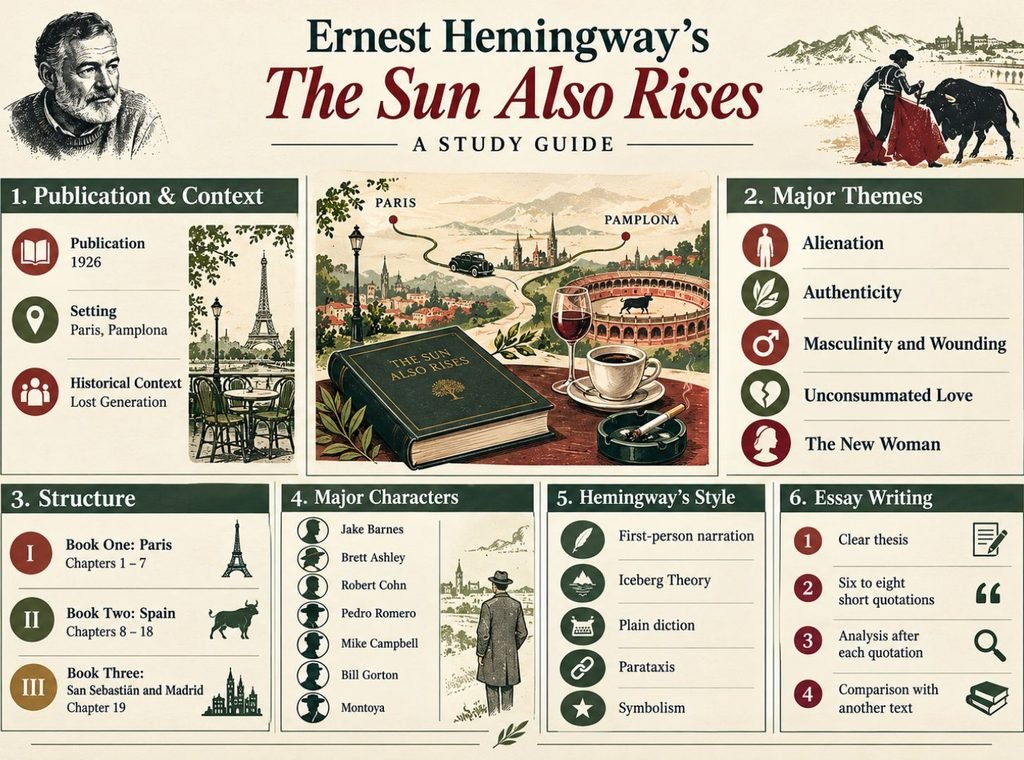
Major Themes in The Sun Also Rises
Most readers remember the novel through the label ‘Lost Generation.’ That label is incomplete. The two epigraphs pull in opposite directions: Stein’s sentence says a generation has been damaged, and Ecclesiastes says the earth goes on without it. EBSCO’s reading of the pair is that they balance each other, with the second suggesting that some values may last through modern loss.
Do not pick a side in your essay. Track which passages support which epigraph. Evidence for damage is easy to find: Jake crying alone in the dark in Chapter 4, Brett leaving every man she takes up, Mike’s bankruptcy, Cohn leaving Pamplona beaten and weeping. Evidence for continuity is quieter. It sits in the five days of fishing at Burguete, in Romero’s work in the ring, and in Jake’s swim at San Sebastián, where the water and the quiet leave him better off than he was in Paris.
Be precise about the word “lost.” Hemingway’s characters know exactly what hurts. Jake gives the nearest thing the novel has to a statement of purpose in Chapter 14, and it is modest.
“I did not care what it was all about. All I wanted to know was how to live in it. Maybe if you found out how to live in it you learned from that what it was all about.” Chapter 14
Notice the verb. Jake wants to learn how to live, which is a practical question, and he postpones the large questions about meaning. That ordering is the book’s answer to a world where faith, patriotism and romance have stopped working.
Five ideas to track
Alienation: Jake moves through cafés as a spectator. In Chapter 12, Bill Gorton tells him, as a joke during the fishing trip, “You spend all your time talking, not working.” It works as a joke because everyone at the table knows it is partly true. Watch how often the expatriates talk about doing things and how rarely they do any.
Authenticity: Spanish has a word the novel borrows: afición, a passionate and informed love of bullfighting. Montoya, the Pamplona hotelier, judges people by it, and Jake has it. When Jake introduces Romero to Brett, he spends the only standing he has with a community that accepts him. Montoya stops treating him as a friend. Of all Jake’s losses, this one costs him the most and gets the fewest words.
Masculinity and wounding: The novel’s men measure themselves in different arenas. Cohn boxes, Mike drinks and insults, Romero fights bulls, and Jake cannot have sex. The book’s first sentence, “Robert Cohn was once middleweight boxing champion of Princeton,” already sets up the question of what a man can prove with his body. In American Literature (1995), Ira Elliott reads Jake’s wound as placing him between conventional gender positions, a place he shares with Brett’s gay friends. You can use that argument or push against it, but you should know it exists.
Love without consummation: Jake and Brett love each other and cannot be lovers. Brett takes up men who can touch her and leaves them. Jake stays. The novel treats their love as real and unlivable. That is more difficult to narrate than a failed romance.
The New Woman: Jake describes Brett’s appearance with a mixture of admiration and resentment: her hair “was brushed back like a boy’s. She started all that.” Brett is separated from Lord Ashley and awaiting a divorce, engaged to Mike, and carrying the memory of a first love who died of dysentery in the war. She sleeps with Cohn in San Sebastián, takes up Romero in Pamplona, and sends Romero away because she believes she would harm him. Judge her by what she does, as the novel’s men rarely do.
How the themes appear without being stated
Hemingway rarely names a theme. Track it through plot, character, symbol, and the rare moments of direct statement.
- Plot: The characters travel through Paris, Pamplona and Madrid in search of an experience intense enough to matter, and each stage ends in disappointment.
- Character: Jake’s silence, Brett’s restlessness, Cohn’s romantic expectations and Romero’s discipline are four responses to the same loss. Together they give four answers to one question.
- Symbol The bulls are untamed nature. The steers lead the bulls into the corral and keep them calm. A steer is a castrated bull, and in the Pamplona chapters Mike compares Cohn to one. Because Jake’s own wound is never far from the page, readers often connect the two. Test that link against the text before you build an argument on it.
- Direct statement: It is rare. When it comes, as in the Chapter 14 passage above or in the final line, it is brief and often phrased as a question.
Structure and Setting in The Sun Also Rises
The novel has nineteen chapters in three books, and the proportions tell you where Hemingway put his weight. Book One has seven chapters, Book Two has eleven, and Book Three has one. More than half the novel takes place in Spain, and the last book is a single chapter long. Ask yourself why the ending is so short.
| Book | Chapters | Place | What changes |
| One | 1 to 7 | Paris | The triangle of Jake, Brett and Cohn forms. Everyone drinks, talks and goes out at night. |
| Two | 8 to 18 | Bayonne, Burguete, Pamplona | Five days of fishing, then the fiesta. Rivalry turns into violence. |
| Three | 19 | San Sebastián, Madrid | The fiesta is over. Jake answers a telegram and the novel ends in a taxi. |
The text gives few dates. Readers place the story in the mid-1920s, with the fiesta modeled on the one Hemingway attended in July 1925. Treat the setting as a set of working conditions for the characters. Paris is where they drink, talk and wait. Its cafés in Montparnasse, including the Select, are where Jake meets people and where nothing is required of anyone. Burguete and the Irati River offer the book’s one stretch of physical work and easy companionship: Jake and Bill fish, play cards, and cool their wine in a stream. Pamplona brings the ritual of the bulls, with Montoya’s hotel as its social center. Madrid is where Brett tells Jake what she has done, and where the book has no more movement left to offer.
The contrast between France and Spain matters to the argument. In Paris the characters can always postpone a decision to the next drink. In Pamplona they stand next to people for whom the bull in the ring is not a figure of speech, and the expatriates look careless by comparison.
The Sun Also Rises Plot Summary
Book One, Paris
Jake opens by describing Robert Cohn, who was middleweight boxing champion of Princeton, learned to box to counter the inferiority he felt about being treated as a Jew there, and has just read a romantic travel book that has convinced him his life is wasting. Jake meets Brett Ashley at a dance club in Montparnasse. In a taxi, the two of them show how much they love each other and how little they can do about it. Cohn falls for Brett on sight. His girlfriend Frances Clyne confronts Jake about Cohn’s plans to leave her. Brett goes to San Sebastián, where she has an affair with Cohn.
What to watch. The first chapter is a portrait of Cohn written by a narrator who will not describe himself for several pages. Ask why Hemingway starts with the man Jake dislikes. Chapter 4 follows Jake home alone at night, and it is the most exposed he is in the entire book.
Book Two, Spain
Bill Gorton arrives from New York and he and Jake travel to Bayonne, where they meet Cohn, then on to Pamplona. Brett and Mike Campbell, her fiancé, do not arrive when expected. Bill and Jake go on to Burguete and spend five days fishing, drinking and playing cards. A letter from Mike brings them back to Pamplona for the fiesta.
The fiesta unravels in stages. Mike taunts Cohn at dinner and the two nearly fight. Brett meets the nineteen-year-old matador Pedro Romero, and Jake introduces them, to Montoya’s disapproval. Cohn finds Jake and Mike at a café, calls Jake a pimp, and knocks Jake out and Mike down. Later the same night he finds Romero with Brett and beats him repeatedly. Romero keeps getting up. Cohn weeps, tries to shake Romero’s hand, and is hit again. In the morning he apologizes to Jake, who forgives him grudgingly, and leaves. Romero goes into the ring still bruised and fights well. Brett leaves Pamplona with him. The fiesta ends and the friends part at Bayonne.
What to watch: Most plot-diagram answers place the climax in Chapters 17 and 18, with Cohn’s assaults and Brett’s departure. A stronger answer observes that the climax changes nothing in Jake’s situation. Everything that happens to everyone else leaves him exactly where he was, and that is the point of the structure.
Book Three, San Sebastián and Madrid
Jake goes to San Sebastián alone and swims. A telegram from Brett asks him to come to Madrid. He takes the overnight train and finds that she has ended things with Romero because she feared she was ruining his career. She wants to go back to Mike. Jake arranges the tickets. In a taxi through Madrid, Brett says they could have had “such a damned good time together,” and Jake gives the novel’s last line.
What to watch. The ending is short on purpose. Nothing is resolved and everything has been said. You will read the final exchange closely in a later section.
Major Characters in The Sun Also Rises
Jake Barnes
Jake narrates, and the novel is built around what he chooses to say. He is an American journalist living in Paris, wounded in the war so that he cannot have sex with the woman he loves. The text does not describe the injury in medical terms. The novel never specifies the injury. Jake’s remarks, Brett’s responses, and the social meaning of impotence in the 1920s lead most readers to infer a war-related genital wound.
Jake does not change much. He starts the book controlled and ironic, and he ends it controlled and ironic, with the difference that by the last chapter he has stopped pretending the control is easy. His main action is facilitation: he introduces Brett to Romero, helps Brett when she is in trouble, and listens to Cohn’s apology. Each of these costs him. You learn who Jake is from what he notices and from what he leaves out.
Brett Ashley
Brett is the most discussed character in the book, and the most readily simplified. Reduce her to a symbol of 1920s freedom, and you lose the scene in Madrid, where she makes a decision that costs her something and tells Jake plainly. She sends Romero away. Her motive may be generous or self-protective, and the text lets you argue both. Be careful with the word “promiscuous.” It tells you what a reader disapproves of and nothing about what Brett wants.
Jake’s description of her appearance in Chapter 3 includes a simile: she was “built with curves like the hull of a racing yacht.” Notice how much of Jake’s feeling is packed into a physical description, and notice that he gives no equivalent description of any man.
Robert Cohn
Cohn is the outsider: he did not fight, he is Jewish in a circle that uses that as an insult, and he takes love seriously. The novel opens with him, and Jake’s first account is a mixture of sympathy and irritation. Jake states that Cohn learned to box to cope with how he was treated as a Jew at Princeton. The novel therefore knows exactly why Cohn is vulnerable and then lets its characters, and at times its narrator, use that vulnerability against him.
A reading you can test against the text: part of Jake’s contempt for Cohn comes from seeing in Cohn an open version of his own longing for Brett. Cohn follows her and says what he wants. Jake does neither. Whether you accept this reading or not, find two places in Chapters 1 to 6 and 17 where Jake describes Cohn in ethnic terms, and decide in each whether the narration endorses the description, merely reports it, or exposes its speaker.
Pedro Romero
Romero is nineteen and he is the only character who is good at something that matters in the world of the book. Jake judges his bullfighting by its plainness: Romero’s movements, he says, are “straight and pure and natural in line.” Hemingway criticism uses the term code hero for a character who lives by a private code of courage and skill when shared belief has failed. Philip Young’s 1952 study of Hemingway developed the term. Hemingway’s own phrase for courage, “grace under pressure,” comes from a 1929 interview with Dorothy Parker in The New Yorker, not from this novel, so do not attribute it to Jake or to the text.
Romero is also the character most open to the charge of being a fantasy: a young, beautiful, uncomplicated man who is brave on demand. The strongest essays on him weigh how much the novel believes in him and how much it shows Jake needing to.
Bill, Mike and Montoya
Bill Gorton is Jake’s friend and the book’s source of ordinary humor. The fishing trip gives Jake his only unforced company, and Bill’s jokes carry a point, as the “You spend all your time talking, not working” speech shows. Mike Campbell is a bankrupt Scottish veteran, engaged to Brett, who humiliates Cohn when he is drunk. Asked how he went bankrupt, he answers, “Two ways. Gradually and then suddenly.” That line gives you his whole character, and you can quote it for several different arguments. Montoya runs the Pamplona hotel and keeps the standards of the bullring. His silence toward Jake after the Romero introduction is one of the novel’s quietest judgments.
Is there a villain?
There is none. Several characters hurt each other and none of them is the cause. Mike’s cruelty, Cohn’s persistence and Brett’s choices all do damage, and the underlying injury, the war, is never on the page. If an exam asks you to name the antagonist, argue that the novel resists the category and give three examples of pressure that has no single source.
How to analyze characterization
Hemingway uses direct statement sparingly, so build your analysis on indirect methods. A common teaching mnemonic is STEAL: Speech (Mike’s slurs, Brett’s short replies), Thoughts (Jake’s ironic asides), Effects on others (how a room changes when Cohn enters), Actions (Jake’s repeated willingness to help Brett), and Looks (Brett’s cropped hair, Romero’s posture in the ring). For Jake, begin with what he does and what he refuses to say. For Brett, begin with Jake’s descriptions of her clothes, hair, and body. Ask whether the narration lets her speak for herself. For Jake, it is actions and omissions. For Brett, it is looks and speech, which tells you something about how Jake sees her.
Hemingway’s Writing Style in The Sun Also Rises
Point of view and the Iceberg Theory
Jake narrates in the first person, and he tells you less than he knows. He does not lie. He is guarded, and the guardedness is the method. In Death in the Afternoon (1932), Hemingway wrote that a writer who knows his subject well enough can leave things out, and that the reader will feel what was omitted as strongly as if it had been stated. The idea is known as the Iceberg Theory, after the image Hemingway used for it: the story is what is written, and the larger part of it is implied.
For you as a student, this means a quotation is only half of the evidence. When you pick a passage, ask a second question: what does Jake leave out here, and how do I know it is there? A good answer points to a nearby sentence, an object, or a change of subject that gives the omission away.
Diction
Hemingway’s vocabulary is plain and concrete. Look at the first two sentences of the book. “Robert Cohn was once middleweight boxing champion of Princeton” runs nine words. Jake continues: “Do not think that I am very much impressed by that as a boxing title, but it meant a lot to Cohn.” That runs twenty-two. The short sentence gives a fact, and the single word “once” tells you the fact is no longer true of Cohn. The long sentence shows Jake correcting himself and judging Cohn in a single sentence.
In the Burguete chapters Jake’s attention goes to things he can name and do: the road, the river, the trout, the wine cooling in a stream. In a letter to Gertrude Stein and Alice B. Toklas on 15 August 1924, Hemingway wrote that he was “trying to do the country like Cezanne and having a hell of a time.” Read a paragraph in the novel that describes the countryside and list what Jake sees. Then list the words he uses for what he feels about it. The second list is much shorter. Louise R. Achuff’s article “’Nice’ and ‘Pleasant’ in the Sun” (The Hemingway Review, 1991) takes up the novel’s plain evaluative words and is a good place to start if you want to write about diction.
Syntax
Hemingway’s sentences are mostly short and declarative, and they often link clauses with “and” or with nothing at all. This is parataxis: clauses placed side by side without words such as “because” or “although” to rank them. The result is that events arrive one after another and the narrator declines to explain how they connect. The effect on a reader is strongest when something painful is reported in the same flat voice as everything else. The final page of the novel, which you will read closely below, is built this way.
Figurative language, tone and mood
Hemingway uses simile and metaphor sparingly, so each one stands out. Brett’s “curves like the hull of a racing yacht” is among the few extended comparisons in the book. The symbols do more work than the figures of speech: the bulls, the steers, the river, the sun. The tone is ironic and, by the end, elegiac. The mood changes from place to place: restless in Paris, violent in Pamplona, exhausted in Madrid. Irony works for Jake in two ways at once. It protects him from sentiment and it gives him a way to be honest without having to say anything directly.
Three Key Passages in The Sun Also Rises
Exam answers on this novel improve most when you stay with a short passage and ask what each sentence does. These three repay that treatment.
1. Jake alone at night (Chapter 4)
Jake has just parted from Brett and goes home alone. The passage turns on two sentences.
“It is awfully easy to be hard-boiled about everything in the daytime, but at night it is another thing.”
“Then I was crying.”
- Count the words. The first sentence has nineteen. The second has four. Ask what the change in length does to your pace as a reader.
- Look at the grammar of the subject. The first sentence is about “it,” an impersonal statement that could apply to anyone. The second is about “I.” Jake drops the general remark and states a personal fact without warning.
- Notice what the passage does not contain. Jake does not describe a feeling beyond the act of crying. Ask what a more explicit narrator would have added and what the reader loses by that addition.
2. Romero in the ring (Chapters 15 to 18)
Jake judges Romero’s bullfighting by its plainness. His movements are “straight and pure and natural in line.” In Chapter 18, Romero fights after Cohn has beaten him the night before.
- Find the passages where Jake describes Romero at work. List the verbs. Count how many describe display and how many describe control.
- Compare Romero’s way of fighting with Cohn’s way of fighting in Chapter 17. Cohn hits Romero repeatedly and cannot make him stay down. Jake’s praise for Romero suggests he values the smallest movement that does the job.
- Ask what Jake is looking for in Romero. The answer says a lot about Jake’s own idea of how a person should behave under strain.
3. The final exchange (Chapter 19)
“Oh, Jake,” Brett said, “we could have had such a damned good time together.” Ahead was a mounted policeman in khaki directing traffic. He raised his baton. The car slowed suddenly pressing Brett against me. “Yes,” I said. “Isn’t it pretty to think so?” Chapter 19
- Look at the three narrated sentences in the middle. They run nine, four and eight words, and none of them mentions a feeling. The narrator reports a policeman, a baton and a car.
- Note the one moment of physical contact in the closing paragraph. The car slows and Brett is pressed against Jake. Nobody chose it.
- Decide what Jake’s reply means. It can be tender, because he accepts that the dream is worth having. It can be bitter, because he will not pretend it was ever possible. It can be both. Defend one reading in your essay, say that the others exist, and show which words make yours more probable.
Antisemitism, Gender, and Brett Ashley in The Sun Also Rises
Hemingway’s greatest gift in this book is restraint, and the restraint has costs. The characters can seem self-absorbed. The plot is thin on events. The pace is deliberate. These are the choices that make the novel what it is, and you can argue they are strengths. Two other problems are harder to defend.
Cohn: Cohn is the target of antisemitic insults, notably from Mike, and the question of whether Jake’s own narration joins in is one to settle line by line, as suggested in the section on Cohn above. The novel recognizes the problem. Jake explains why Cohn learned to box, and the scene in which Cohn weeps and asks forgiveness gives him dignity. Yet the narrative never condemns the abuse. A responsible reading says so without excusing it and without reading the book as a simple endorsement.
Brett: The novel both admires Brett and punishes her. She is vivid, honest and brave, and she is also the person on whom every man’s frustration lands. For the gender questions, read Elliott’s 1995 article alongside the book and test its argument about Jake against the way Brett and her friends are written.
A method for essays on these questions: first, identify the passage and say plainly what is said. Second, decide whose view it is, Jake’s, a character’s, or Hemingway’s, and what evidence supports your choice. Third, decide what the passage does to your sympathy for the person targeted. You do not need to defend Hemingway’s treatment of Cohn or Brett. You need to show where the text exposes prejudice, where it repeats it, and where Jake’s narration makes the distinction difficult.
Reading It Today
The city of Pamplona keeps a Hemingway section on its tourism website, which treats the novel as part of the history of the fiesta. The book remains readable because Jake’s habit of organizing his life around an unspoken injury is still recognizable. A person who has been hurt, does not discuss it, and organizes his life around not discussing it. Sherlyn Abdoo has written about Jake’s insomnia, and a modern reader will likely describe Jake’s nights, Mike’s drinking and Brett’s restlessness in the vocabulary of trauma, which Hemingway did not have. You can use that vocabulary, but say that it is yours and not the novel’s.
You may read Brett as a woman making decisions in a world that gives her little room, and you may be less willing than Jake is to accept the labels others put on her. That is an argument, so find the lines in the text that support it.
How to Write an Essay on The Sun Also Rises
Planning a 2,000-word essay
- Write your claim in one or two sentences before you write anything else. If you cannot, you do not have a claim yet.
- Plan roughly 200 words for the opening, four body paragraphs of about 350 words each, and 200 words for the close.
- Use six to eight quotations. Keep each under thirty words, and follow each with at least two sentences of your own analysis.
- Name your sources inside the sentence. “Ira Elliott reads Jake’s wound as placing him between conventional gender positions” is a citation. “Critics say” is not.
- Close by extending the argument: compare the novel with another text or raise a question you could not settle. Do not close by praising the novel’s reputation.
Three thesis statements to adapt
- The novel’s two epigraphs do not cancel each other. Jake’s narration shows damage and continuity in the same scene, and the Burguete chapters are the clearest example.
- Montoya’s withdrawal from Jake after the Romero introduction is the book’s most precise statement of what Jake’s loyalty to Brett costs him.
- Hemingway’s treatment of Cohn tests how far a narrator’s sympathy can go before it reaches the limits of his own prejudice.
A model essay
Question: Jake Barnes says very little about his wound. What does the novel gain from that silence?
Hemingway gives Jake Barnes a wound and then lets him say almost nothing about it. Readers learn that Jake was hurt in the war, that he loves Brett Ashley, and that the two cannot be lovers. The injury itself is never described in detail. The silence is a method. It makes the reader do the work of feeling, and the feeling that results is harder to dismiss than a confession would have been.
The clearest evidence comes in Chapter 4. After parting from Brett, Jake goes home alone and reflects: “It is awfully easy to be hard-boiled about everything in the daytime, but at night it is another thing.” The sentence begins as a general rule about people and admits that the rule fails after dark. Later in the passage the subject changes from “it” to “I”: “Then I was crying.” Jake never explains the sentence. The impersonal statement gives way to a personal one, and the flatness with which the fact is reported gives the reader what a long account of grief might not.
The silence also decides how other people treat Jake. Brett confides her affairs to him. Cohn, after the fistfight in Chapter 17, lies in the dark and begs his forgiveness. Because Jake asks for nothing and expects nothing, the people around him use him as the one person to whom they can say anything. The novel never says that this is a kind of loneliness, and it does not have to. The reader sees that Jake hears everything and is told nothing.
The silence has a price, and Montoya makes it visible. Jake introduces Brett to Romero, and the hotelier who valued Jake’s afición stops treating him as a friend. Jake reports the change in a few sentences. What he does not report is how much the loss hurts a man who has no other community. The reader supplies that, and the book is more honest for relying on the reader to do it.
The final scene concentrates all of this. Brett says that they could have had “such a damned good time together,” and Jake replies: “Yes. Isn’t it pretty to think so?” The reply refuses both comfort and complaint. A narrator who has said little for nineteen chapters says one small thing more, and it is a question. The reader must decide whether the tone is tender or bitter, and the decision shows how much of the novel’s meaning has been left to the person holding the book.
The method has limits, and an honest essay should name them. Because Jake tells us so little, readers can credit him with feelings he never claims, and his judgments of others, Cohn above all, receive less challenge from the narration than they should. The restraint that makes Jake affecting also protects his prejudices from scrutiny. A comparison with Hemingway’s story “Big Two-Hearted River,” where Nick Adams fishes in silence and the war is never named, raises the question this essay cannot settle: whether Jake’s silence is a form of honesty or a form of avoidance, and whether the novel can tell the difference.
What the model essay does
- It states a claim in the first paragraph and does not wait until the end.
- Each paragraph opens with a sentence that makes a point, then proves it with a quotation and analysis.
- It quotes short passages exactly and says what the grammar of the quoted sentence is doing.
- It includes a paragraph on the method’s limits, placed where the argument needs it.
- It ends on a comparison and an open question.
Further Reading
Entries below are grouped by what they help you do. Check edition details in your library catalogue before you cite any of them.
The author in his own words
- Hemingway, Ernest. The Sun Also Rises. New York: Charles Scribner’s Sons, 1926. Quote from one edition throughout your essay and give the chapter number with each quotation.
- Hemingway, Ernest. A Moveable Feast. New York: Charles Scribner’s Sons, 1964. The memoir contains the scene in which Stein repeats the phrase “lost generation.” Hemingway wrote it long after the events, so treat it as his account and not as a record.
- Hemingway, Ernest. Death in the Afternoon. New York: Charles Scribner’s Sons, 1932. His book on bullfighting, and the source for his remarks on leaving things out of a story.
- Sanderson, Rena, Sandra Spanier and Robert W. Trogdon, eds. The Letters of Ernest Hemingway, Volume 3, 1926 to 1929. Cambridge: Cambridge University Press, 2015. The place to find his letters to Maxwell Perkins about the novel, with the exact wording and dates.
Criticism on the novel
- Baker, Carlos. Hemingway: The Writer as Artist. Princeton: Princeton University Press, 1952. An early full-length study of the fiction. Read the chapter on this novel for its handling of the Ecclesiastes epigraph.
- Young, Philip. Ernest Hemingway. New York: Rinehart, 1952. Where the idea of the code hero gets its fullest early treatment.
- Reynolds, Michael S. The Sun Also Rises: A Novel of the Twenties. Boston: Twayne, 1988. A book-length reading of the novel in its period. His Hemingway: The Paris Years (Oxford: Blackwell, 1989) covers the biographical background.
- Wagner-Martin, Linda, ed. New Essays on The Sun Also Rises. Cambridge: Cambridge University Press, 1987. A collection of essays by several scholars. Her edited casebook, Ernest Hemingway’s The Sun Also Rises: A Casebook (Oxford: Oxford University Press, 2002), is also worth finding.
- Grebstein, Sheldon Norman. Hemingway’s Craft. Carbondale: Southern Illinois University Press, 1973. On technique, including how Hemingway builds a sentence.
- Elliott, Ira. “Performance Art: Jake Barnes and ‘Masculine’ Signification in The Sun Also Rises.” American Literature 67.1 (1995): 77 to 94. On how the war wound places Jake in relation to ideas of masculinity.
- Adair, William. “Cafes and Food: Allusions to the Great War in The Sun Also Rises.” Journal of Modern Literature 25.1 (2001): 127 to 33. Useful if you want to write about the setting and the war together.
- Achuff, Louise R. “’Nice’ and ‘Pleasant’ in the Sun.” The Hemingway Review 10.2 (1991): 42 to 46. On the novel’s plain evaluative words.
- Abdoo, Sherlyn. “Jake Barnes’ Insomnia and Fiesta Nightmare in The Sun Also Rises.” In The Elemental Dialectic of Light and Darkness, ed. Anna-Teresa Tymieniecka. Dordrecht: Kluwer, 1992. 249 to 68. On Jake’s nights.
- The online bibliography of criticism on the novel hosted at Washington State University (public.wsu.edu/~campbelld) lists about three hundred books and articles. Use it to find essays on any single theme.
Connections to other works
- F. Scott Fitzgerald, The Great Gatsby (1925). Published the year Hemingway began this novel. Both books use an American narrator who watches a circle of careless people and says less than he feels. Compare how far Nick Carraway and Jake Barnes can be trusted
- Hemingway, “Big Two-Hearted River” (1925). A story in which Nick Adams fishes alone and the war is never named. Compare it with the Burguete chapters and with the model essay’s closing question.
- Hemingway, A Farewell to Arms (1929). Another war novel by Hemingway, this time with a love story that ends in loss. Compare Catherine Barkley and Brett Ashley
- T. S. Eliot, The Waste Land (1922). A poem about the same postwar condition, written in a different form. Compare how each text refuses to explain itself
- Ecclesiastes 1:1 to 11. The source of the title and the second epigraph. Read the whole passage and decide how much of its tone the novel keeps.
- Gertrude Stein, Everybody’s Autobiography (1937). Stein’s own account of where “lost generation” came from, which differs from Hemingway’s
- Jean Rhys, Quartet (1928). A novel about a woman among expatriates in Paris in the same decade. Compare her position with Brett’s
Exam-Style Questions
- In Chapter 2, Jake tells Cohn, “You can’t get away from yourself by moving from one place to another.” How does the rest of the novel test that claim in Burguete, Pamplona and San Sebastián?
- Does the novel side with Stein’s “lost generation” or with the earth that “abideth forever”? Argue your answer from at least two passages.
- Read the last page of the novel closely. What does the sentence “Isn’t it pretty to think so?” do, and what does the narration around it leave out?
- “Montoya’s silence is the novel’s quietest punishment.” Discuss with reference to Jake’s part in bringing Brett and Romero together.
- Is Cohn a target of the narrative or a character it treats with sympathy? Use Chapter 1 and Chapter 17 in your answer.
- Brett sends Romero away in Book Three. Is this her only unselfish act in the novel? Consider the alternative readings.
- Compare how Hemingway handles silence about the war in The Sun Also Rises and in “Big Two-Hearted River.”

Author: mkalam
Educator and content creator